This lecture will focus on art as an instrument of politics under Mao Tse-tung’s China (1946-1976) and post-Mao China (usually marked by Deng Hsiao-ping’s economic reform from 1978 to the ’00 decade). These two distinct periods demonstrate how a mass communication tool can be used to inspire, homogenize, dictate, cajole, invent and reinvent, transform and rejuvenate a society, for the better or for the worse.
The lecture will not be an exploration of art history, aesthetics, or the multiple schools that flourished during the Mao and post-Mao periods. Instead, representative examples will be used to illustrate the central theme: How art was used as a political and socio-political instrument par excellence during the second half of twentieth-century China.
Presented by Dorothy Chen-Courtin, MA, PhD, Asian Art History, Columbia University, MBA, Northeastern University, Founder and President of Marketing & Management Associates for Nonprofits, Board member, Greater Lowell Community Foundation, The Worcester Art Museum, and Beth-Israel Lahey Medical Center.
Join us in-person or online!
If you plan to attend in person at the Museums, tickets are available on the day of the lecture in the Welcome Center.
To attend via ZOOM, please register in advance.
Members Only!
If you are attending in person, join docent Betty Romer for a tour of the Chinese galleries in the George Walter Vincent Smith Art Museum following this A La Carte presentation.
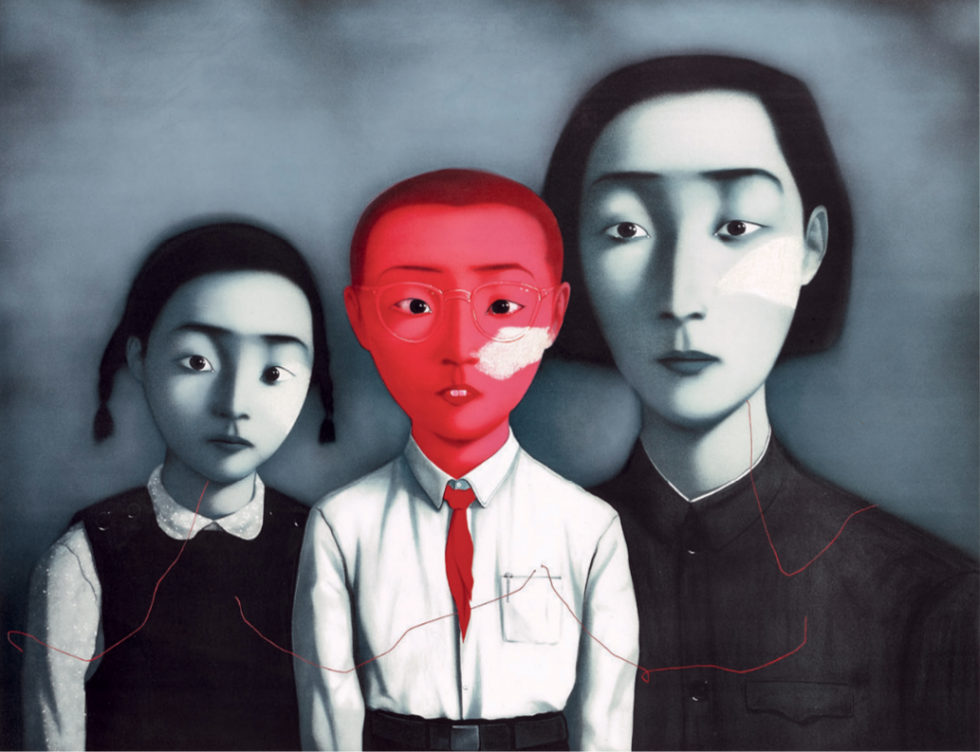
Image Above: Zhang Xiao-gang (Chinese, b. 1958), Bloodline series: Big Family, 2006, 30.5 X 36.7 inches, Lithograph in colors, source, Artnet Auctions, www.artnet.com