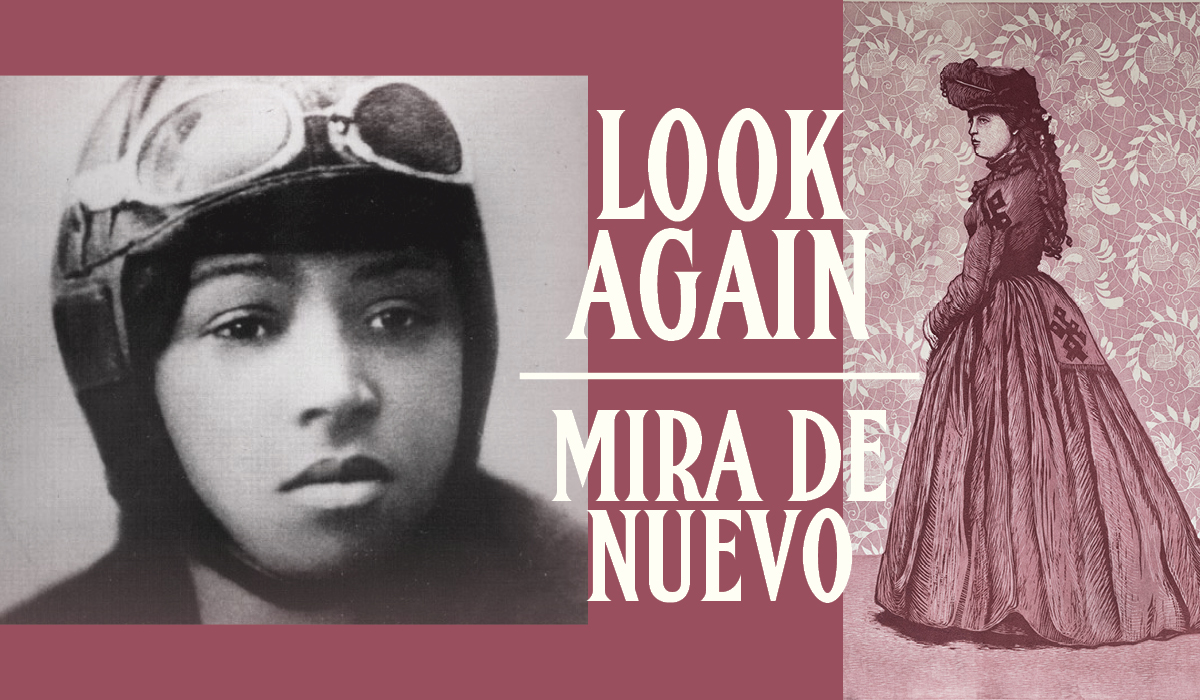
Look Again: Belle Townsley Smith and Bessie Coleman
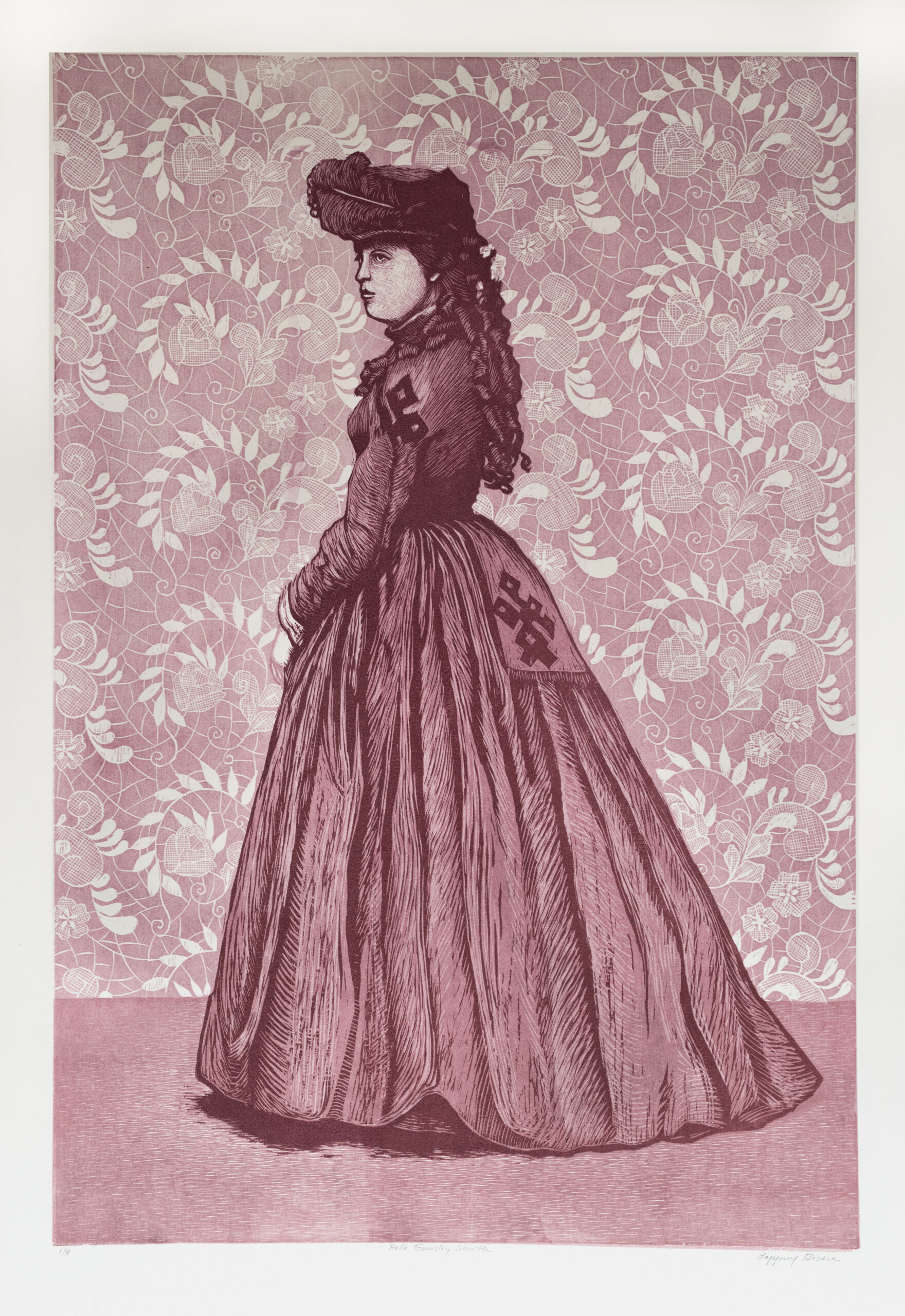
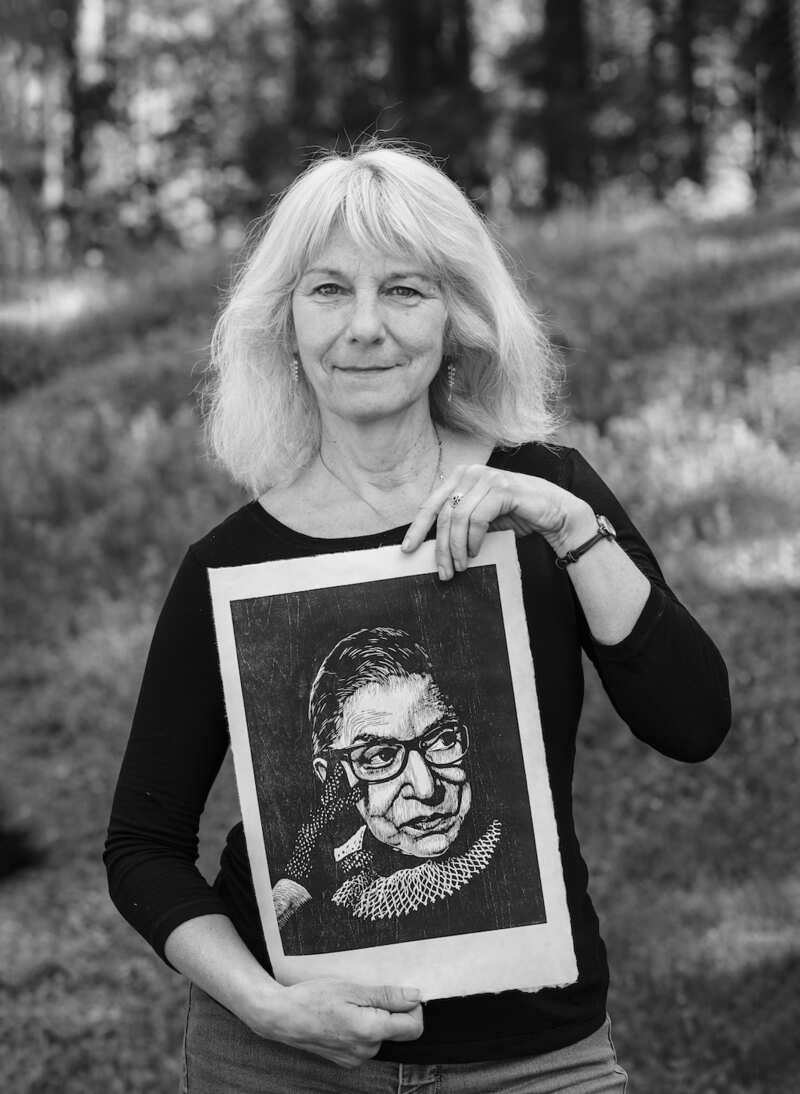
Look Again: Portraits of Daring Women by Julie Lapping Rivera is an homage to exceptional, pioneering women working across centuries. In a series of hand-carved, woodcut and collage prints, Leverett-based artist Julie Rivera (American, b. 1956) highlights the lives and achievements of women who defied the status quo. Each print is accompanied by a poem, written specifically for the series, by local and international women poets.
Look Again is sponsored by the Community Foundation of Western Massachusetts

Belle Townsley Smith (1845-1928) believed in the power of beauty to improve lives. After marrying the successful carriage-maker and art collector George Walter Vincent Smith in 1869, the couple amassed objects from around the globe, later founding their own museum of art in Springfield, Massachusetts. Belle concentrated her collecting on textiles, including Italian cutwork lace, rose point lace, and varieties of French lace. Following George’s death in 1923, Belle became the honorary director of the George Walter Vincent Smith Museum and oversaw its expansion. Towards the end of her life, Belle arranged to be succeeded by two women professionals— the Museum’s curator Eleanor A. Wade and assistant curator Cordelia C. Sergeant. The Smiths were devoted to the Museum and chose, following their deaths, to have their remains interred into its second floor.
The George and Belle Smith Art Museum Has a Fine Ring to It
by Sharon Tracy
Born and buried in Springfield
she co-founded the city’s first art museum
named for her husband alone:
George Walter Vincent Smith Art Museum
See for yourself. It gleams above
the main doors.
Newly married, they set off for Europe
in 1882 and two years of collecting art
soon turned into five—jade and lacquer,
Chinese cloisonné, 19th century landscape paintings,
armor, illuminated manuscripts, ceramics.
Returning, they offered the collection as one,
a gift to her city if they would build it a home.
A passion of hers was lacemaking, the handiwork
of women in the waning days of the handmade.
With a lacemaker’s keen eye she sought out
the finest—Italian cutwork, French rose-point
and Spanish lace, created with needle or bobbins
and threads of linen or silk as fine as a spider’s web,
forming holes and solids to create cuffs, veils,
mantillas and lappets, lace strips worn by bishops
and popes or attached to a woman’s hair in pairs.
Motif, pattern, then the execution—hands and fingers
drawing the edges through eyelets, the openwork
web growing into something delicate and beautiful.
Covering yet revealing. Painstakingly made. Belle
Townsley Smith organized the museum’s exhibit
of handmade lace in 1912 to great fanfare.
Today, walking across the Quadrangle
as you approach the Pompeian brick façade,
it’s hard not to wonder if anyone
ever spoke up, suggesting that he
give up one of his given names so that one
of hers could fit on the building.
A legacy handed down.
After all, the museum was her child.
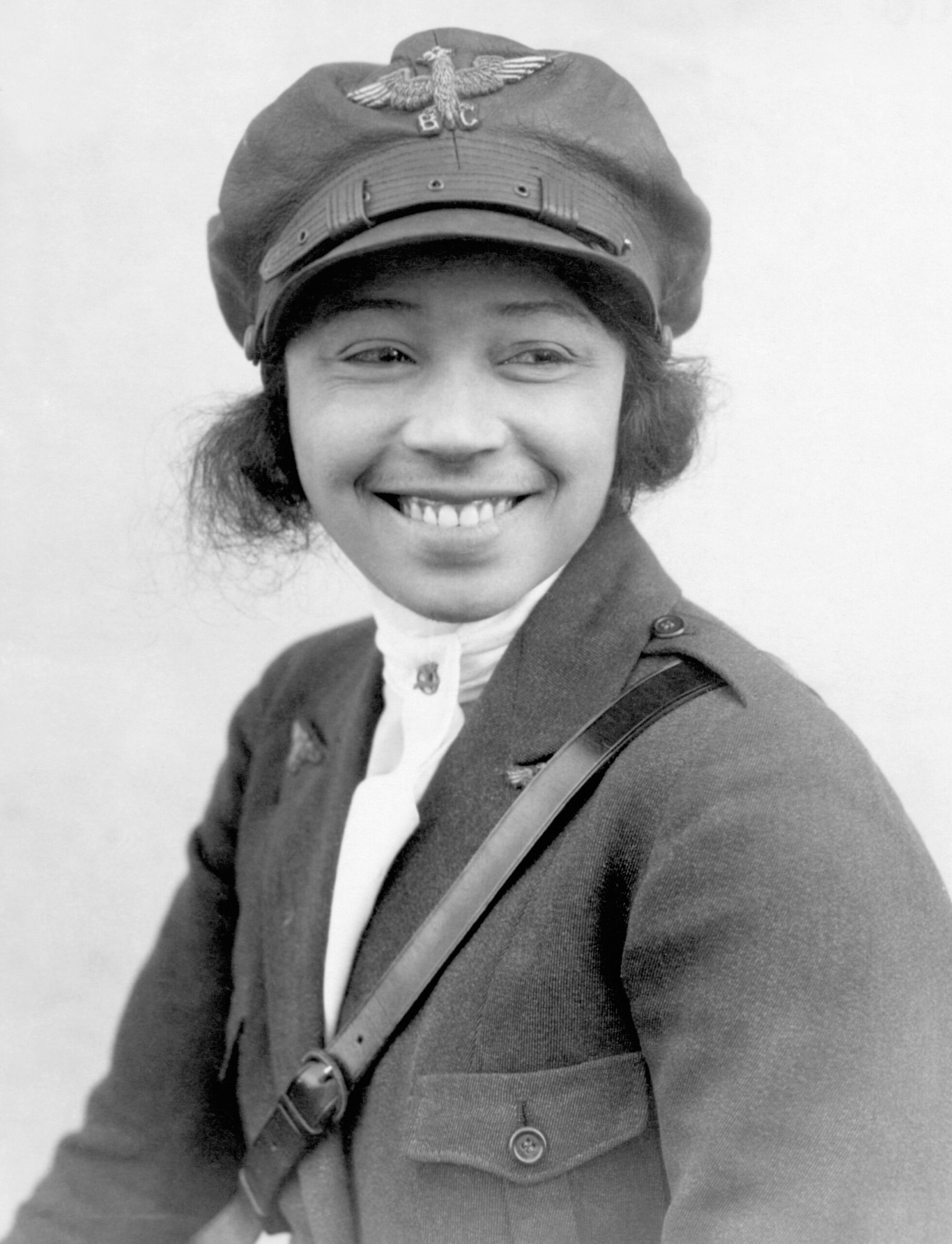
Soaring high while performing loop-the-loops, tail spins, and other aerial maneuvers, Bessie Coleman (1893 – 1926) dazzled spectators and became a media sensation in the 1920s. The first African American woman to earn a pilot’s license, Coleman was initially unable to find a flying instructor in the United States. Undeterred, she applied to pilot schools in France, teaching herself the language and soliciting benefactors to support her. Tragically, at age 34, a plane malfunction dropped Coleman approximately 500 feet through the air, and she died upon impact. Five years later, the Challenger Pilot’s Association began to honor her memory by flying over her grave every year. A trailblazer, Coleman is remembered for her adventurous spirit.
Queen Bess
by Sharon Tracey
Built for flight, for soaring, she who
always checked her wings, the weather—
aviatrix, wing-walker, barnstormer,
first black woman pilot in the U.S.—
heard the stories of WWI flyers at the White Sox
Barber Shop in Chicago as she worked doing nails.
The military selling surplus “Jennys” in the twenties
(she would own two). And yet, to earn her pilot’s license,
the sharecropper’s daughter raised in Waxahachie, Texas
had to leave the country, train in France. The biplane
mostly wings, no steering wheel, no brakes.
If you fly above the earth does the world look truer?
She flew figure eights, dipping and looping, stuntwoman
and guide of her sky-self, parting the blue—
the see-through clouds, fully licensed to operate.
Demanded blacks and whites enter the same front gate.
She was thirty-four the last morning.
You don’t need to look up the weather report,
it was said to be a wrench—jammed—that sent her Jenny
spiraling, nose-diving, past the future roundabouts
to be named after her, the flying schools she dreamed of
the pilots flying low, dropping blossoms on her grave.
About the Artist
Julie Rivera is inspired by the meditative practice of woodcut printmaking. She began her career in New York, working as a teaching artist with the Studio in a School Association, the Museum of Modern Art, and the Lincoln Center Institute. Rivera earned her MFA in Painting from Pratt Institute and her BFA in Printmaking from the University of Massachusetts, Amherst. She is a New York Foundation for the Arts Fellowship recipient in Drawing and received grants from the New York Foundation of the Arts, the National Endowment of the Arts, and the Massachusetts Cultural Council. Rivera is a Leverett-based artist. She teaches printmaking at Smith College and at Zea Mays Printmaking in Florence, MA.
About the Poet
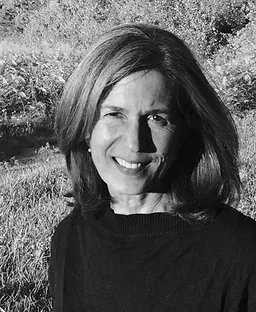
Sharon Tracey is a poet and editor and author of three poetry books: Land Marks (Shanti Arts 2022), Chroma: Five Centuries of Women Artists (Shanti Arts), and What I Remember Most is Everything (All Caps Publishing). Her poems have appeared in Crab Creek Review, Terrain.org, Radar Poetry, The Ekphrastic Review, and elsewhere.
She previously worked as a director of research communications and interdisciplinary environmental initiatives at the University of Massachusetts Amherst and recently served on the board of Perugia Press, a publisher of women poets. She holds a Master’s degree in public policy from the University of California Berkeley.

Related Posts