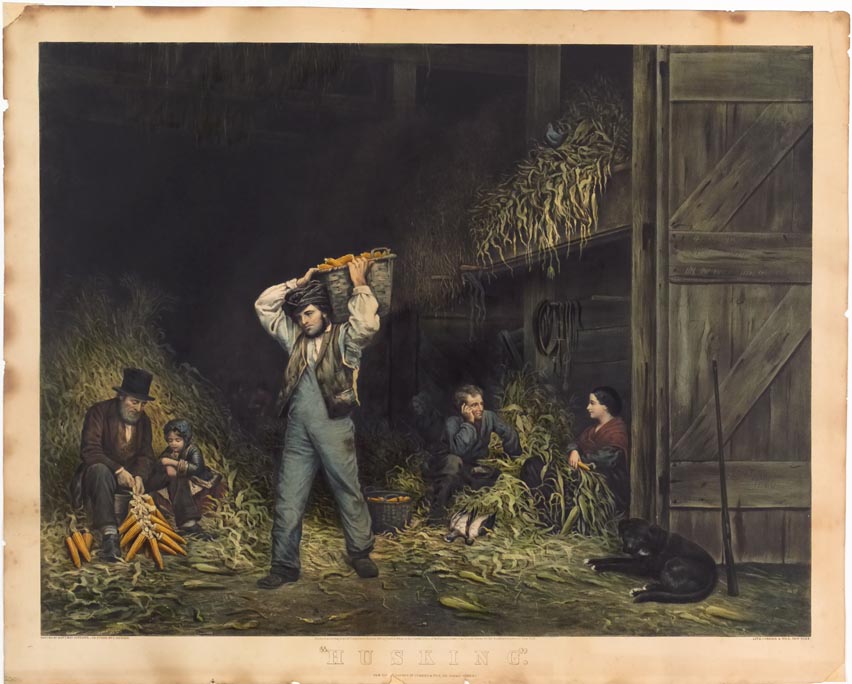
Barn scene. Man at center carrying on shoulder basket filled with husked ears of corn. Man and child seated to left roping ears into garland. Man and woman seated to right amidst corn husk remains. Dog by door.
Lithographed by Charles Severin American, 1820-death date unknown After Eastman Johnson American, 1824-1906 Husking, one of the most celebrated Currier & Ives prints, was created after a painting by Eastman Johnson. A successful painter for more than 60 years, Johnson was noted for his portraits and scenes of everyday life. He produced Husking and other genre scenes while visiting the island of Nantucket in Massachusetts. Often considered among the best of Johnson’s works, both the painting and the print had wide appeal. Currier & Ives recognized that the American public, weary from the anxiety caused by the Civil War as well as from the industrial life of the city, needed an escape. In response, the firm published a number of serene genre prints depicting the quieter side of American life, especially that of the farmer. This detailed scene shows several men, women and children gathered in a barn to husk corn. Although the message of the scene is one of hard work, the picture also speaks to the pleasures of life, represented by the young couple engaged in friendly conversation.