The Starry Scoop: May 2023
Read your monthly astronomy news with “The Starry Scoop” by Kaitlynn Goulette! Follow them on Facebook to have their updates placed directly on your feed!
Editor: Kaitlynn Goulette
May 2023, Edition 38
WHAT’S UP
Following sunset this month, the Big Dipper can be found very close to the zenith and is a terrific navigational tool. The two stars farthest from the handle, Dubhe and Merak, can be used to point to the North Star, Polaris, as shown on the map below. In the other direction, these “Pointer Stars” lead us south to the constellation Leo the lion. Utilizing the arc of the Dipper’s handle, we can also “arc to Arcturus,” “spike to Spica,” and “continue on to Corvus the crow.”
Looking to the west, our evening sky features the planets Mars and Venus, which look like bright stars to the unaided eye. Venus reaches its highest point during mid- to late May and glows at magnitude -4.3. Mars can be found about 17 degrees east of Venus, glowing a reddish-orange color. The crescent moon joins these planets from May 22nd to the 25th. In our morning sky, Saturn can be seen about two hours before sunrise, with Jupiter making its appearance about 30 minutes before the sun joins the sky.
The Eta Aquarid meteor shower runs annually from April 19th to May 28th and peaks this month on the evening of the 5th into the following morning. In the Northern Hemisphere this shower produces about 30 meteors per hour. The full moon blocks the dimmer meteors this year, but the brighter “shooting stars” will still be visible. For best viewing, find yourself a dark location after midnight.
Fifty years ago on May 25th, Skylab 2 was launched. It was the first crewed mission to American’s earliest space station, Skylab, which was launched earlier in the month on May 14th. This crew performed the first repair spacewalk to fix a broken solar array, allowing Skylab to receive enough power to continue operating. Science Pilot Joseph P. Kerwin became the first medical doctor in space and studied the effects spaceflight has on the human body. This crew was also the first to safely return to Earth after inhabiting a space station and set a new record for the longest duration of human spaceflight (28 days).
MAY’S SKY

Hold star map above your head and align with compass points.
5: Full Moon
5-6: Eta Aquarid Meteor Shower Peak
19: New Moon
29: Mercury at Greatest Western Elongation
OBSERVATIONS
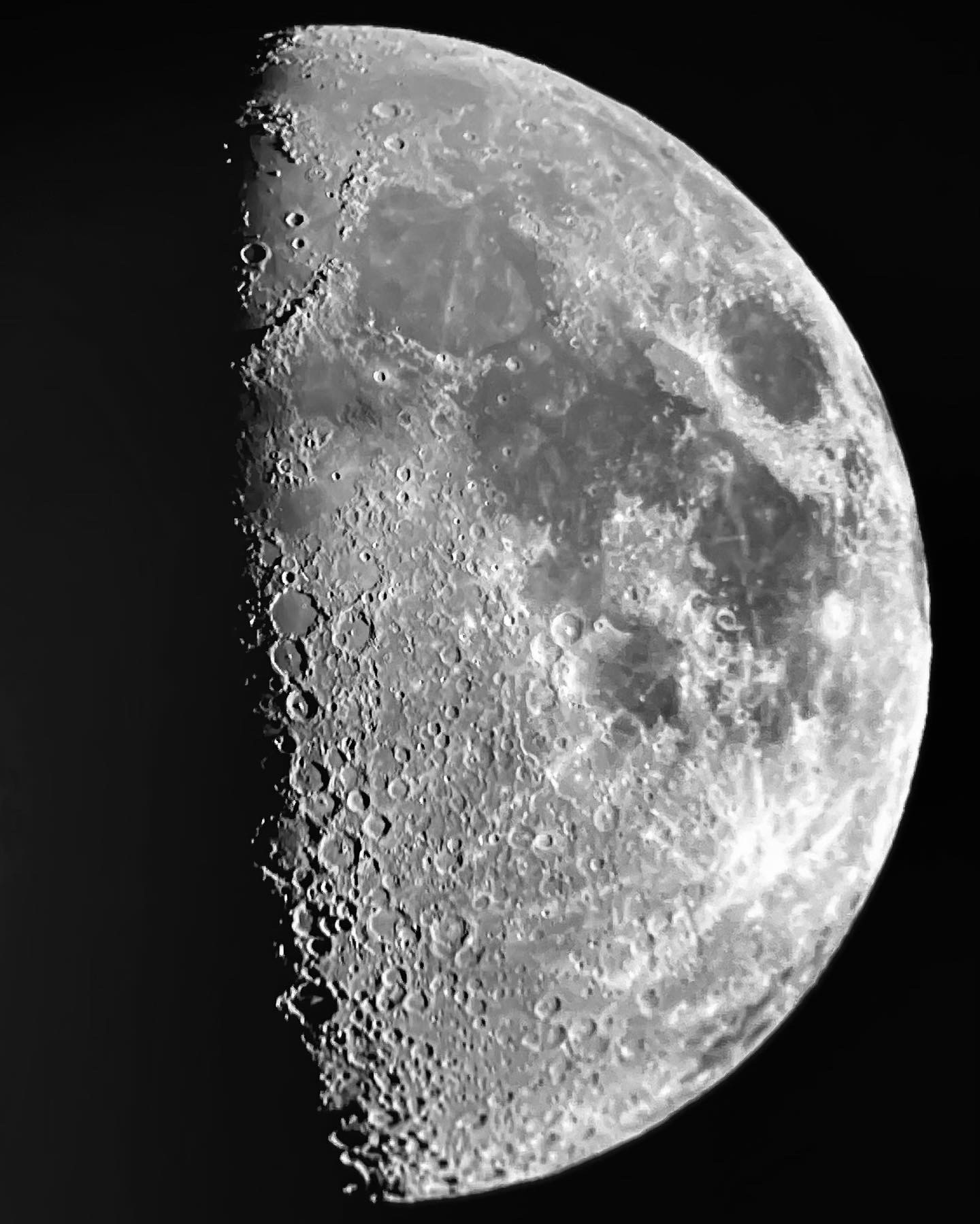
The Westfield High School Space and Astronomy Club recently held an observing event, which included both the Westfield Intermediate School (5th and 6th grade) and Middle School (7th and 8th grade). The first quarter moon was the highlight of the evening. One telescope featured the moon all night, with some students viewing it through a telescope for the very first time. The club’s homemade 10-inch “Gravel” Dobsonian telescope featured multiple deep sky objects. The Orion Nebula was by far the favorite target through this telescope.
My family recently traveled down to Washington, D.C. for school vacation week and we had an opportunity to stargaze with the National Capital Astronomers. Clouds blanketed the sky at sunset, but as if a switch had been flipped, the heavens opened up following twilight. My fellow high school astronomy club member and good friend Lani Ching joined me, and we had the pleasure of touring the universe through club members’ telescopes. We greatly enjoyed viewing many deep sky objects through their eVscopes. Two observations worth mentioning are the Orion Nebula and Whirlpool Galaxy. With the eVscope’s technology, the details of these objects were comparable to digital images.
Lani and I, along with our families, attended two planetarium shows at the National Air and Space Museum, and one at the Rock Creek National Park.
OBJECT OF THE MONTH
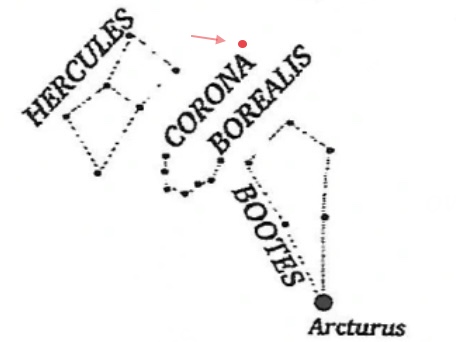
The carbon star V Coronae Borealis is May’s featured object and is located in the constellation Corona Borealis. It’s a long-period variable star at a distance of about 8,800 light years. During its 357-day period, this star ranges in apparent magnitude from 6.9 to 12.6. Carbon stars are typically older red giant stars that are nearing the final stages of their lives. Their atmospheres contain an abundance of carbon, hence their name, which forms a dusty layer that scatters blue and green light, allowing only red and orange light to reach us. This causes carbon stars to shine a beautiful red color, much like a ruby. Use the star map below to help you find this object. A telescope is needed to view it. Good luck!
The purpose of the Starry Scoop is to communicate current astronomy and space events. If you want to share your observations or get digital copies of the Starry Scoop, contact starryscoop@gmail.com. The Starry Scoop is now on Facebook. Clear skies!
Image: The Moon, photo by Kaitlynn Goulette

Related Posts