
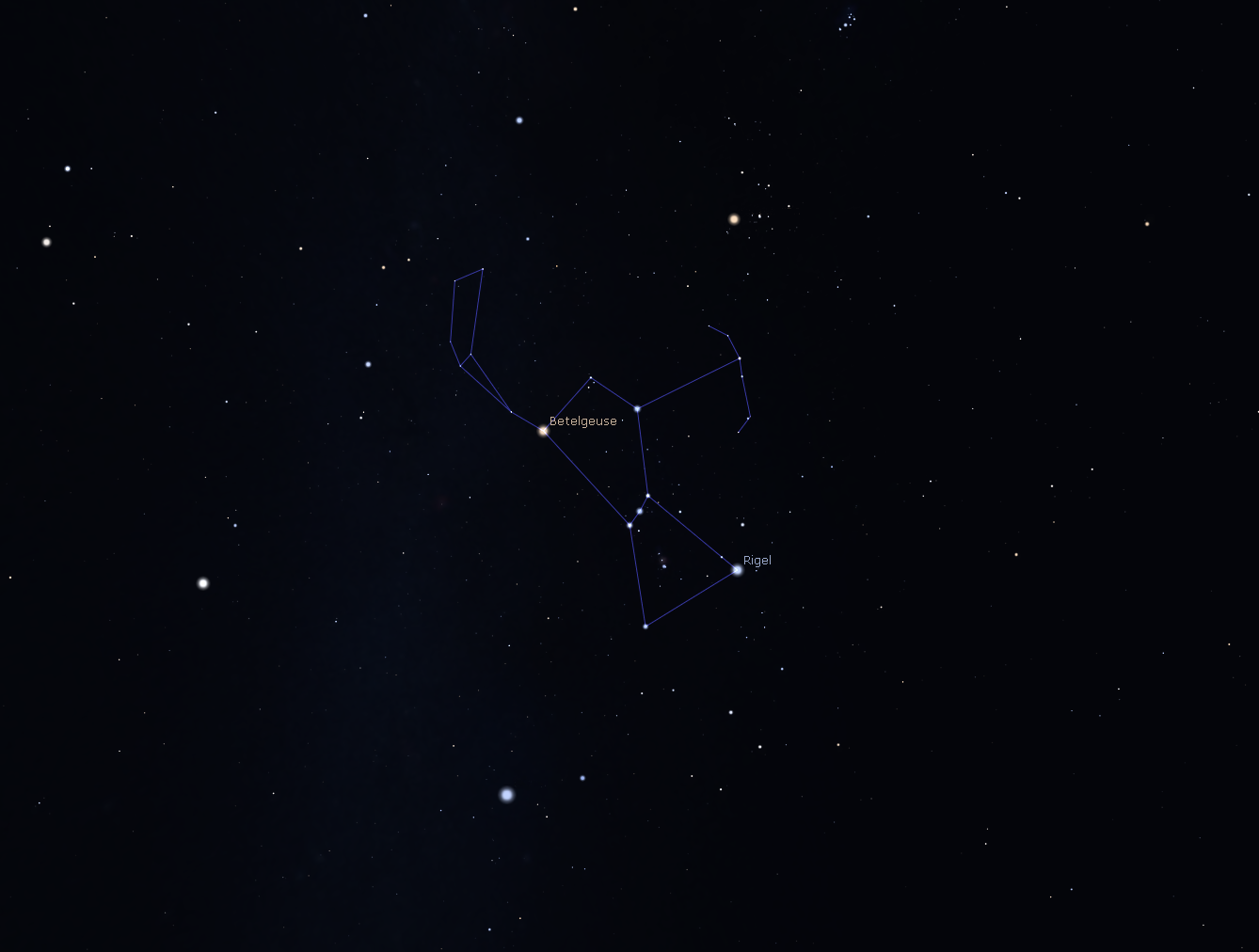
The Greek names for constellations became official designations in 1922. Yet, many names for the stars in those constellations are derived from Arabic words, and this points to a Middle-eastern connection to the sky that both pre-dates and follows the Greek civilization. We’ll look at the post-Greek connection here.
The most famous star name of all, Betelgeuse, is Arabic in origin. It is the upper right star of the figure we know today as Orion. The scholar George A. Davis Jr investigated the origins of star names in the mid 20th century. His work is highly regarded in this field. His quest led him to learn Arabic and several ancient languages as well. His best determination is that the name derives from the Arabic Ibt al-Jauza, “the armpit of the white-belted sheep.”
What – no hunter? The ancient pre-Islamic Arabs saw this area as the white-belted sheep. The earliest reference to the top 2 stars of this figure is “the shepherd of the white-belted sheep.” Later the shepherd was dropped and the entire figure referred to only the sheep with Betelgeuse in the position of an armpit. This is one of the many stories of the history of star names.
Around the year 150, the Greek astronomer Ptolemy wrote a star catalog including what we now know as the 48 classical constellations. We know this work today thanks to Arabic scholars who translated his work into Arabic during the 700s and gave this work the title we know it by, Almagest. The great Arabic astronomer Al-Sufi made an updated version of the Almagest, naming his version the Book of the Fixed Stars, which contained many Arabic star names.
It wasn’t until 1175 that the Arabic manuscripts were translated into Latin. They were published in 1515. During the post-Greek time of Arabic stewardship, many of the names by which we know the stars became established, and included Arabic as well as Greek names.
Here are some other examples of Arab star names we use today as researched by Davis:
The Big Dipper bowl stars are named for their position in the bear figure, although the bear itself is from the Greeks:
- Dubhe, Zahr ad-Dubb al-Akbar, “the back of the greater bear”
- Merak, Maraqq ad-Dubb al-Akbar, “the loins of the greater bear”
- Phecda, Fakhidh ad-Dubb al Akbar, “the thigh of the greater bear”
- Megrez, Maghriz adh-Dhanab ad-Dubb al-Akbar, “the root of the tail of the greater bear”
Here are two of the many “tail” stars:
- Deneb in Cygnus the Swan, Dhanab ad-Daja-ja, “the hen’s tail”
- Denebola in Leo, Dhanab al-Asad, “the lion’s tail”
The two bright stars in Libra have names that just roll off the tongue:
- Zubenelgenubi, az-Zuban al-Janubi, “the southern claw”
- Zubeneschamali, az-Zuban ash-Shamali, “the northern claw”
These were the original claws of the scorpion. The Romans removed them to form the constellation Libra. We’ll cover some history of the constellations in future blogs.
I’ll conclude with an aside about George Davis that is too good to pass up. He was a lawyer by profession with a degree from Harvard Law school. After becoming renowned as a scholar of constellation and star names he taught astronomy. His law studies interfered with his first career: they made him late for baseball spring training in 1914. Later that year, playing for the Miracle Boston Braves, he pitched a no hitter against the Phillies. Truly a man of many accomplishments.
Kevin Kopchynski is the planetarium educator at the Springfield Science Museum. He can be reached at planetarium@springfieldmuseums.org.
Reading List
- George A. Davis’ manuscript, courtesy of the Maria Mitchell Observatory
- Ian Ridpath on Arab influences in astronomy
- The Other George Davi
- Iron Davis was a man of the Stars
Featured image: The stars of Orion, image courtesy of stellarium.org