
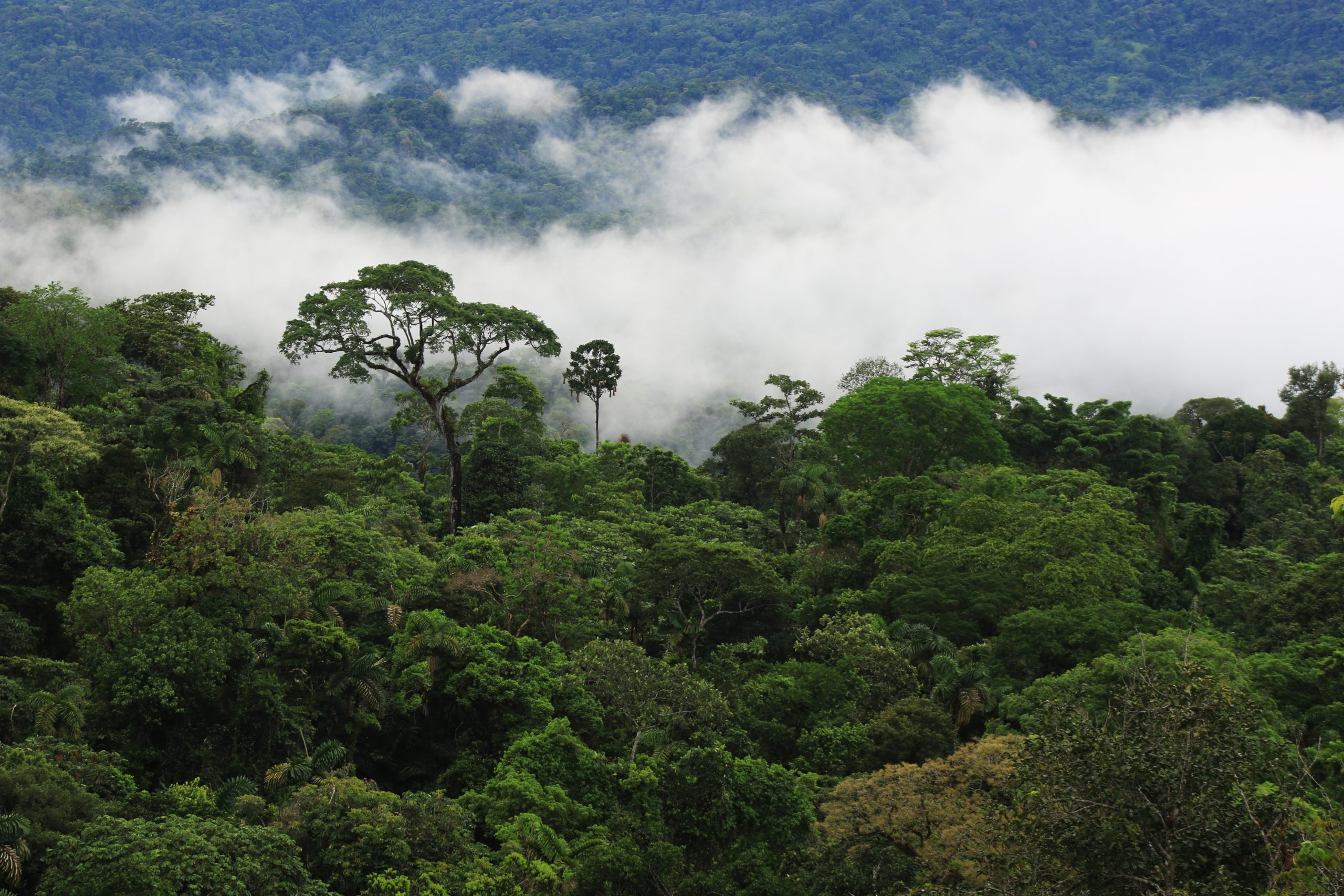
The Springfield Museums’ Live Animal Center has quite a collection of live animals from the rainforests of South America. Just as the animals from the Wild Kratts: Creature Power exhibition display their special creature powers, the Springfield Museums’ live rainforest animals display some very interesting adaptations which can be observed in their naturalistic habitats. Before we explore these rainforest critters and their special adaptations, let’s begin with some background information about rainforests.
Rainforests are highly diverse biomes that are located worldwide in specific regions within the tropics, specifically between the Tropic of Cancer (23° 27′N) and the Tropic of Capricorn (23° 27′S). The characteristic dense, hot, humid, wet, jungle environment of a rainforest biome is the result of a specific climate caused by a combination of ocean currents, wind patterns, and mountain ranges. The major threats to the rainforests are logging, hunting, deforestation, fire, invasive species, and climate change.
The world’s five major rainforest regions are the Amazon River basin in South America, the Congo River basin in Africa, the island of Madagascar, the Malay Peninsula and islands of Southeast Asia, and the island of New Guinea off of Australia (see Corlett p. 1). Globally rainforests comprise about 7% of the earth’s surface yet are home to over 50% of the earth’s biodiversity (Myers 1988, Wilson 1988, Kricher p. 2). Each of these major rainforest biomes is uniquely different as are many of the surrounding ecosystems. For this essay, we’ll focus our attention on the rainforests of South and Central America.
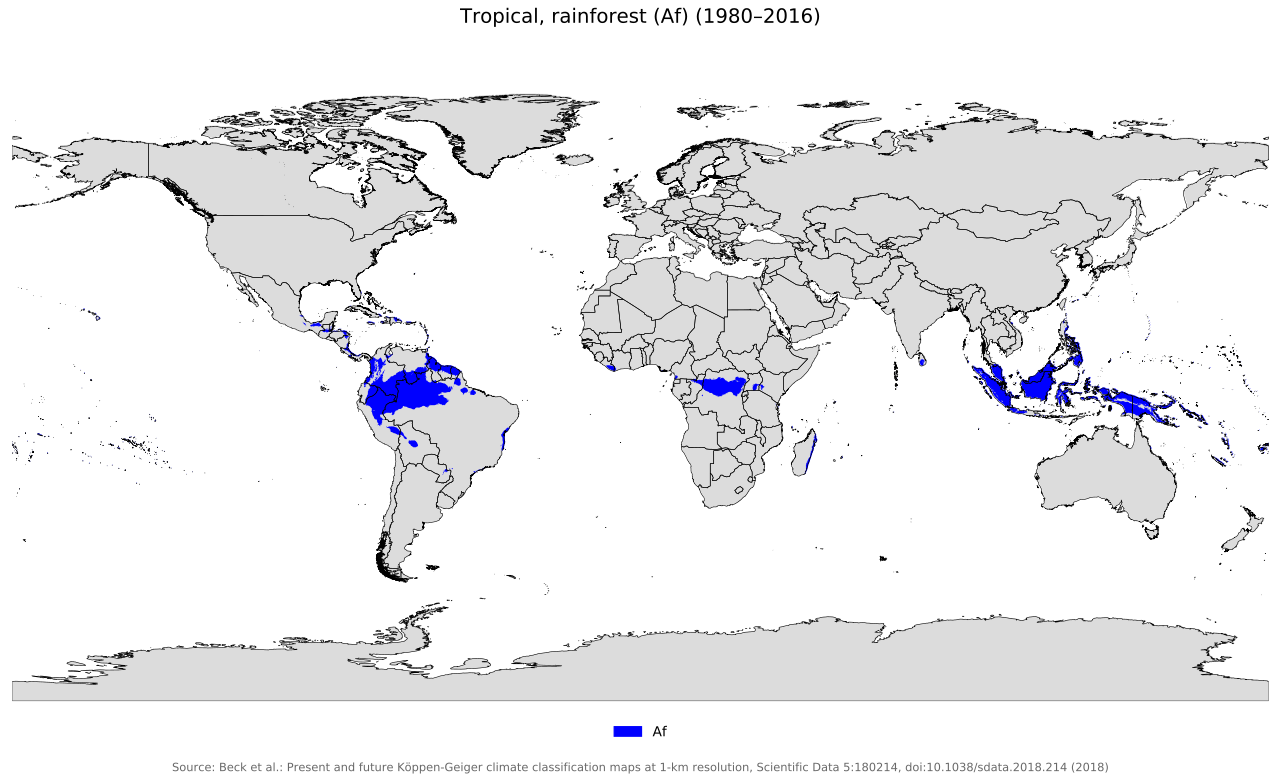
The Amazon rainforest is the largest rainforest region comprising over 50% of the world’s rainforests and containing 50% of the world’s biodiversity (Kricher 2). The Springfield Museums’ Live Animal Center has a collection of animals from the rainforests of South and Central America. These live animal habitats are the South American Flooded Forest Exhibit, South American Understory Exhibit, South American Matamata Turtle Exhibit, South American Poison Arrow Frog Exhibit, and the Red-eyed Tree Frog Exhibit. Let’s look at each of these exhibits in turn.
The South American Flooded Forest Exhibit is an example of an Amazonian river habitat during the flood season. During the rainy season rivers such as the Amazon flood into the South American rainforest allowing fish such as the Pacu (Colossoma macropomum) to swim under the forest tree canopy. During the flood season many of the rainforest trees are dropping their fruits and seeds into rivers. Pacu which are also called Tambaqui (Tom-BAH-kee) are adapted to eating floating fruits and seeds such as palm fruits (Astroscaryum jauari) and rubber tree seeds, (Hevea pruceana) (Kricher p. 204). The pacu’s special adaptation of eating fruits and seeds serves as a very important seed dispersal system for rainforest trees.
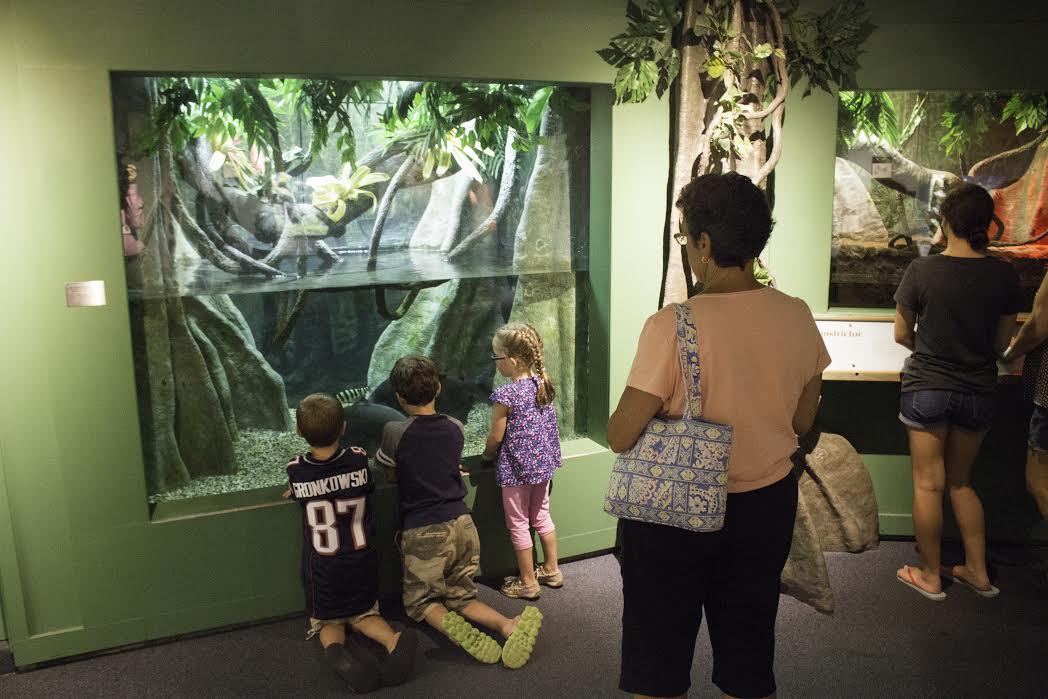
The South American Understory Exhibit is the rainforest habitat found under the larger trees and above the ground. The understory is home to smaller plants and an increasing diversity of animal life such as insects, frogs, and small mammals. An adult red-tailed boa constrictor (Boa constrictor) is living in this exhibit. The boa can often be found living in the low lying branches of the understory and will sometimes venture to the forest floor to hunt for prey. The color pattern of the boa helps it to blend in with the leaf litter of the rainforest floor. The Boa’s diet consists of mammals such as agoutis and rats, although they will also eat birds and even bats. A Boa constrictor is specially adapted to kill its prey by constriction. The boa will quickly strike its prey and hold it in its mouth while wrapping its body around it. The boa will then tighten coils of its body around its prey

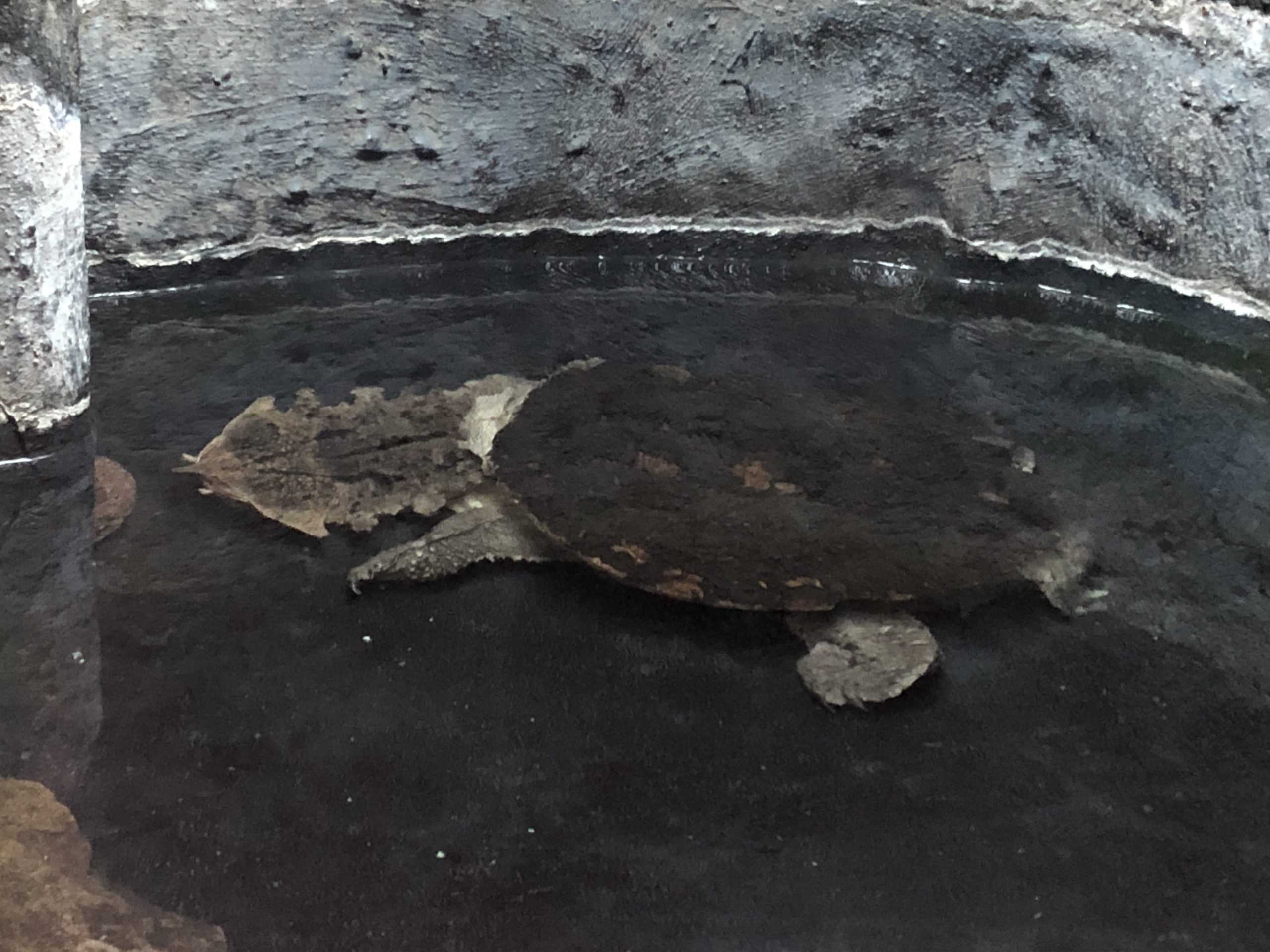
The Matamata Turtle Exhibit demonstrates the rainforest habitat of shallow, muddy streams and riverine pools in northern South America. There is a single, very unique looking Matamata turtle (Chelus fimbriatus) living here. The Latin name of the Matamata turtle means “fringed turtle” and refers to the small tufts of flesh that can be seen along the turtle’s long neck and flat, triangular head. The Matamata turtle is specially adapted to look like dead, decomposing, leaves and vegetation which is typically found on the bottom of the slow moving, murky waters where the turtle lives. These tufts along the head and neck of the turtle contain nerves which are sensitive to the movement of water and may help the turtle to find its prey in the low visibility waters in which it lives. Well-camouflaged, a hungry matamata will remain almost motionless on the stream bottom until a small fish swims near. The matamata turtle will then quickly reach forward, open its mouth and “suck” the fish (along with a lot of water) into its mouth. Luckily, its throat stretches quite a bit and can hold the extra water. Quickly snapping its mouth closed to a slit, the turtle slowly releases the water and swallows the fish whole.
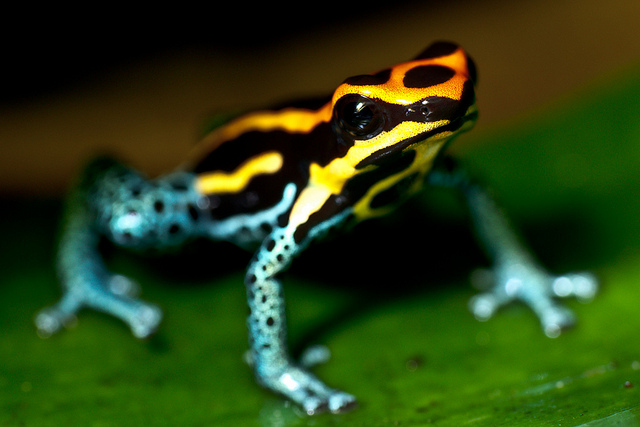
The South American Poison Arrow Frog Exhibit is an example of a habitat found on the rainforest floor. The forest floor is a low light environment dominated by leaf litter. There is very little plant life here. The poison dart frogs which can be observed in this exhibit are the dyeing dart frog (Dendrobates tinctorius), green-and-black dart frog (D.auratus), bumblebee dart frog (D. leucomalis), and phantasmal poison frog (Epipedobates tricolor). These small, brightly colored frogs are not shy about being out in the open during the day, however, their bright colors are their special adaptation which warns predators of their highly toxic nature. The toxin is produced in skin glands from chemicals acquired from the frog’s diet of small rainforest insects. Though poisonous in the wild, our captive bred dart frogs eat fruit flies and do not produce the toxin.
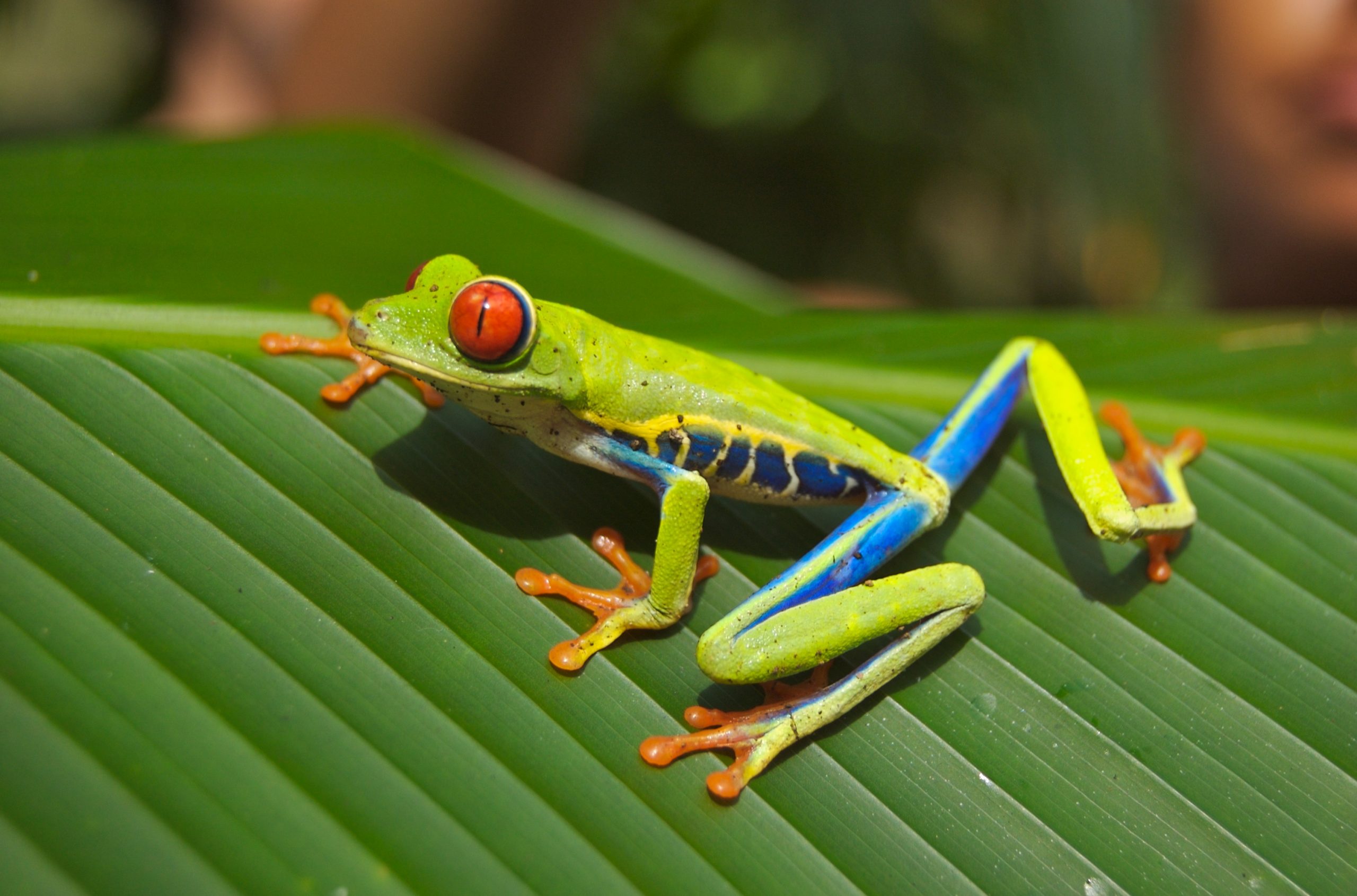
The Red-eyed Tree Frog Exhibit is an example of a rainforest canopy habitat. Red-eyed tree frogs (Agalychnis callidryas) live in the trees of the tropical rainforests of Central America. There are five red-eyed tree frogs living in our exhibit. While many brightly colored frogs are toxic, Red-eyed tree frogs are not. Their vivid green color serves as excellent camouflage within the tropical foliage of the rainforest canopy. When a predator approaches, Red-eyed tree frogs exhibit a special adaptation: by quickly opening their bright red eyes and flashing the bright blue patterns around their legs, they startle their predators and make their escape. Red-eyed tree frogs are nocturnal, so during the day it might be difficult to see them in the exhibit. You might find them resting with their eyes shut and legs tucked under their bodies, looking like green lumps on a branch or leaf.
Further Reading
- Corlett, Richard T., Richard B. Primack. Tropical Rain Forests: An Ecological and Biogeographical Comparison, 2nd Edition. U.K. Wiley-Blackwell: 2011
- Forsyth, Adrian and Ken Miyata. Tropical Nature. New York: Touchstone, 1984.
- Kricher, John. A Neotropical Companion. 2nd ed. Princeton: Princeton University Press, 1997.
- Lowman, Margaret D. Lowman, Edward Burgess and James Burgess. It’s a Jungle Up There: More Tales from the Treetops. New Have: Yale University Press, 2006.
- Walter Carson (Editor), Stefan Schnitzer (Editor) Tropical Forest Community Ecology, Wiley-Blackwell; 1 edition (2011)
- Whitmore, T.C. An Introduction to Tropical Rain Forests. 2nd ed. New York: Oxford University Press, 1998.
Daniel Augustino is the Aquarist at the Springfield Science Museum.