Happy National Pencil Day!
On March 30, 1858, Hymen Lipman patented an invention that would become known to students, artists, and writers around the world. Lipman’s simple yet groundbreaking design combined two existing devices: the familiar graphite pencil and a small rubber eraser. Although Lipman’s patent expired in 1875, his commonsense innovation revolutionized the pencil industry and by the 1920s, most pencils sold in the United States were equipped with handy erasers.
Although pencils with built-in erasers were not used before the 19th century, the story of the pencil, and the related history of graphite, traverses hundreds of years. In celebration of National Pencil Day, the Springfield Museums explore this history and offer a close look at two examples of graphite drawings from the collection of the D’Amour Museum of Fine Arts.
In western art academies of 16th through 19th centuries, graphite was thought to be an ideal preparatory medium. Although used by students learning to draw or by painters planning compositions, graphite was not considered suitable for the creation of a finished artwork. One excellent example of a graphite sketch that finds a home at the Springfield Museums, Sheet of Figure Studies, was created in the 18th century by the Italian artist Giovanni Paolo Panini (1691- 1765). Panini was a skilled draftsman, but he is best known for his paintings of Roman vistas and ruins. In this sketch, he captures a man with a tricorne hat standing in various poses. Although not associated with a specific painting, Panini’s sketch may have been used by the artist as practice, or to determine part of a larger composition.
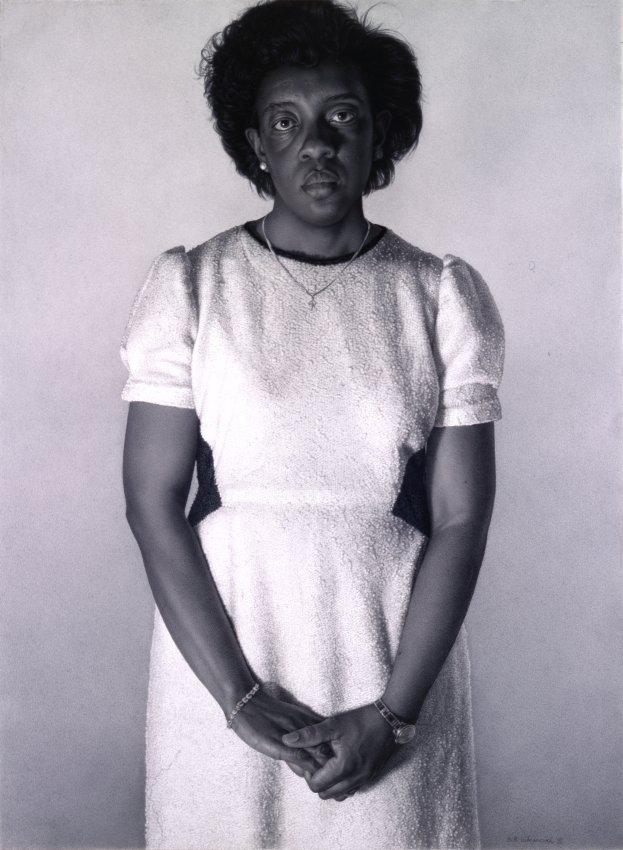
In the early 20th century, artists began to consider uses of drawing and graphite that extended beyond preparation or practice. Modernist painters and sculptors working in Europe and the Americas looked to sources outside of the academy for training. While some artists were drawn to folk art or children’s art, others looked to non-western artistic traditions for inspiration. Around the same time, trailblazers like Georges Braque (1882-1963) and Hannah Höch (1889-1978) embraced a freer use of media, incorporating newspaper clippings and photographs into their compositions. This wave of experimentation that swept the art world resulted in a renewed embrace of graphite and the drawn aesthetic. Bill Vuksanovich’s (born 1938) graphite drawing titled Rita was created in 1991 and is currently on display in the D’Amour Museum of Fine Arts’ Modern and Contemporary Art Gallery. A highly realistic work, the drawing features a dignified subject who meets the viewer’s gaze. Certainly, the nearly life-size drawing was intended as finished project, but it is just one example of a creative, contemporary application of a storied tool: the graphite pencil.
Pick up a pencil! What will you invent, draw, or write today?
Image above: Rita, 1993, graphite on paper by William Vuksanovich (American, born 1938) DMFA-94.D06

 Maggie North is Curator of Art for the Springfield Museums

Related Posts