The Starry Scoop: April 2023
Read your monthly astronomy news with “The Starry Scoop” by Kaitlynn Goulette! Follow them on Facebook to have their updates placed directly on your feed!
Editor: Kaitlynn Goulette
April 2023, Edition 37
WHAT’S UP
After nightfall, our winter constellations can be spotted in the southwestern sky as they make their seasonal plunge toward the horizon. Leo the Lion can be seen high in the south with its “backwards question mark” asterism, making it easily recognizable. Found ahead of the lion lurks Cancer the crab. Within Cancer and visible with the unaided eye is the Beehive Cluster, designated Messier 44. Consisting of about 1,000 stars gravitationally bound together, it lies 610 light years away, making it one of the closest clusters to Earth.
Throughout the entire month, our “Evening Star” and “Sister Planet” Venus is the brightest starlike object in the western sky. By month’s end, it lies about 30 degrees above the horizon at dusk, shining at -4.1 magnitude. Higher in the sky is brilliant Mars. This planet is an excellent unaided-eye target as its red-orange color is fun to compare with the nearby white-blue stars. Due to its orbital location and small apparent size, resolving its features with a telescope is a challenge.
The Lyrid meteor shower runs annually from April 16th to the 25th and peaks this month on the evening of the 22nd into the following morning. This shower produces about 20 meteors per hour and with the crescent moon setting early in the evening, even the fainter meteors will be visible. The meteors radiate from the constellation Lyra but can be seen anywhere in the sky. For best viewing, find yourself a dark location away from light pollution after midnight.
On April 7th, 40 years ago, Donald Peterson and F. Story Musgrave completed the first spacewalk of the Shuttle program. The goal of this spacewalk was to test new spacesuits called Extravehicular Mobility Units, the airlock of the Space Shuttle, and find new ways to repair the outside of the Shuttle. As they were orbiting the earth at 17,500 miles an hour, Peterson’s waist ring on his suit rotated out of place, causing a leak. Peterson and Musgrave both worked fast and were able to move the seal back into place. When they completed the spacewalk, the two astronauts had logged just over four hours.
APRIL’S SKY

Hold star map above your head and align with compass points.
6: Full Moon
11: Mercury at Greatest Eastern Elongation
20: New Moon
22-23: Lyrid Meteor Shower
OBSERVATIONS
I recently had the opportunity to stargaze with members of the Westfield Intermediate School Space and Astronomy Club using their school’s library telescope. The first target of the night was the planet Venus, blazing just over the trees in the western sky. The two sixth graders practiced using the red-dot finder scope and focusing the eyepiece to get a sharp image. Afterwards, we shifted our gaze to Mars. This planet shone with a red-orange hue and was fun to compare to nearby stars. Sadly, clouds began spotting the skies and we had to cut the night short. The sixth graders went home proud and excited about teaching other students how to use their library telescope.
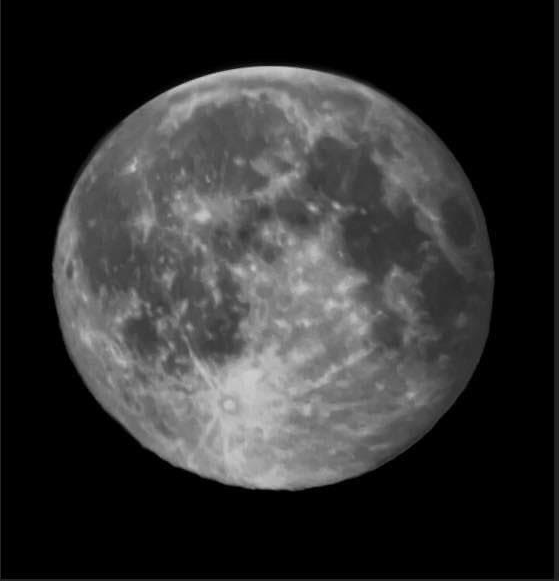
My good friend Lani Ching has been stargazing every clear night with her new 8-inch Apertura Dobsonian telescope. Using her 2-inch, 30mm widefield eyepiece, she enjoys scouring the skies from one target to the next. Lani’s favorite target to observe is the moon. She loves examining the craters positioned along the terminator and captures these views by holding her iPhone against the eyepiece. Along with the moon, she enjoys viewing Jupiter and Mars, which she also photographs with her iPhone. In the future, Lani plans to bring her telescope to dark sky sites and observe faint galaxies and other deep sky treasures.
OBJECT OF THE MONTH
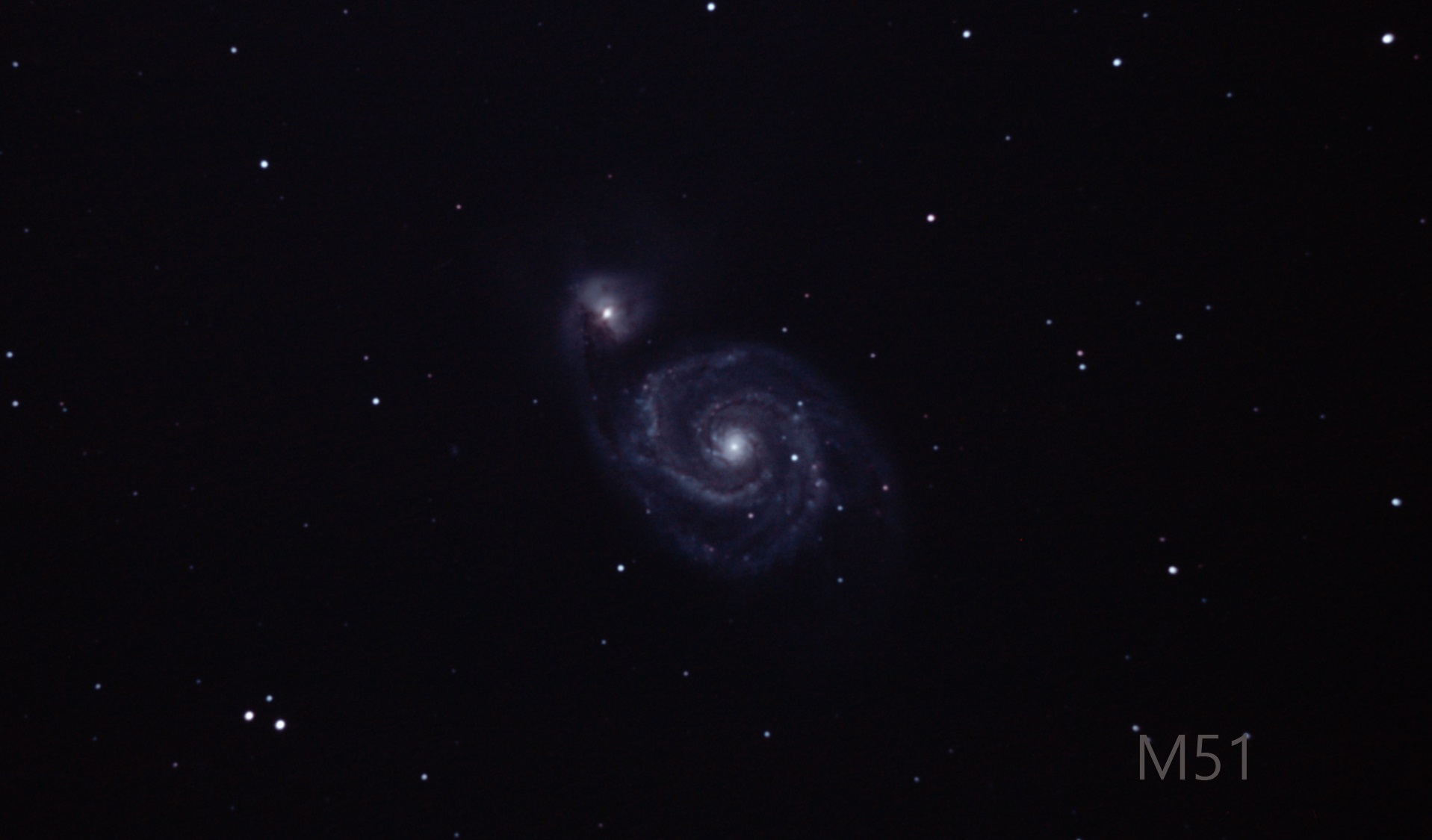
The featured object for the month of April is the Whirlpool Galaxy, designated Messier 51 (M51). This object is one of the most well-known galaxies in the sky and is interacting with its neighbor, NGC 5195. It shines at magnitude 7.9 and was the first galaxy recognized to have spiral structure.
Find this galaxy about three and a half degrees southeast of the last star in the Big Dipper’s handle. Under dark skies, a pair of binoculars is capable of revealing this object, but a backyard telescope resolves much more detail. Clear skies and good luck!
The purpose of the Starry Scoop is to communicate current astronomy and space events. If you want to share your observations or get digital copies of the Starry Scoop, contact starryscoop@gmail.com. The Starry Scoop is now on Facebook.
Image: The Moon, photo by Lani Ching

Related Posts