The Starry Scoop: March 2023
Read your monthly astronomy news with “The Starry Scoop” by Kaitlynn Goulette! Follow them on Facebook to have their updates placed directly on your feed!
Editor: Kaitlynn Goulette
March 2023, Edition 36
WHAT’S UP
After sunset, Jupiter and Venus can be found in the western sky as two brilliant starlike objects. The two worlds will appear with less than a half-degree of separation on March 1st. As the month progresses, Jupiter appears closer to the horizon each night as Venus, our “Evening Star,” climbs higher. During the last week of the month, Mercury is visible in the western sky shining at magnitude -1.1 and will remain a naked eye target until mid-April. The crescent moon joins this region on the 23rd and 24th. Mars can also be found high in the evening sky all month. This reddish planet is positioned in the constellation Taurus for most of the month and moves into Gemini during the last week, where it will be joined by the moon on the 27th and 28th.
The winter constellations have moved into the southwestern sky but continue to be great targets for stargazers. Rising in the east, Leo the lion ushers in the spring season. This constellation is easy to spot because the stars in its mane and forequarters appear as a backwards question mark, also known as the “Sickle” asterism.
One of the most well-known collections of astronomical objects is the Messier catalog. It consists of 110 objects and was created by Charles Messier during the 1700s. The Messier Marathon is a fun challenge for astronomers, who attempt to observe all 110 objects in one night. We have this opportunity from mid-March to early April, with the best nights falling on the weekend of March 18th. A backyard telescope is required to complete this fun observing challenge.
The March equinox, which marks the first day of spring, occurs on the 20th this month for those of us in the Northern Hemisphere. On this day, the sun shines from directly overhead on the equator, making the day and night hours equal.
Sixty-five years ago on March 17th, Vanguard 1 was launched and became the first solar-powered satellite. This was the fourth successful spacecraft and helped test the feasibility of a three-stage launch vehicle. Today, Vanguard 1 remains in orbit around Earth and is the oldest man-made object in space.
MARCH’S SKY
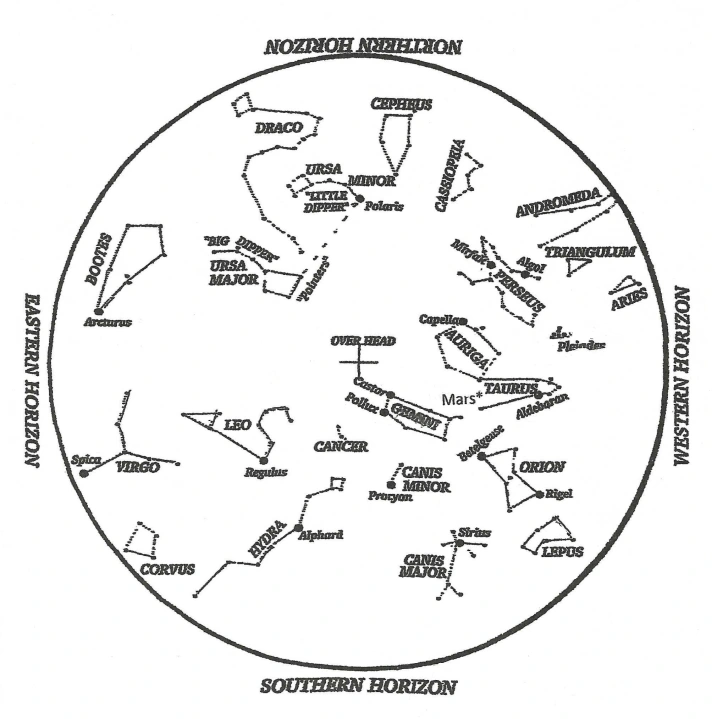
Hold star map above your head and align with compass points.
7: Full Moon
20: March Equinox
21: New Moon
OBSERVATIONS
My good friend Lani Ching recently joined me for a fantastic evening of stargazing. We observed a medley of targets consisting of the Orion Nebula, Pleiades star cluster, Andromeda galaxy, and Mars through my 8-inch Dobsonian telescope. We also decided to observe the “Green Comet,” which has been featured on the news recently. I feel it was an underwhelming comet that got much more hype than it deserved. But nonetheless, we captured a few images of it using my Canon DSLR camera as it was passing within two degrees of Mars.
After reading fellow Springfield (MA) STARS Club member Warren Carrington’s posts on Facebook about observing and imaging the sun, I was motivated to view the sun and its details through a solar telescope. I was excited to observe many features on the sun’s surface and multiple prominences around its edge. I also captured an image of the sun using my Canon DSLR camera.
In contrast to observing the sun, I also had an opportunity to view our moon and observe both the “Lunar X” and “Lunar V” features. They are visible along the moon’s terminator for a short time around the first quarter phase and are a result of illuminated peaks amongst shadowed valleys.
OBJECT OF THE MONTH
The featured object for the month of March is Messier 41 (M41), located in the constellation Canis Major. Sometimes referred to as the Little Beehive Cluster, this bright open cluster is comprised of about 100 stars and is estimated to be about 190 million years old. In 325 BC, Aristotle recorded it as a peculiar “cloudy spot” in the sky, making it the faintest object recorded of this time.
This object can be found about four degrees south of Sirius, the brightest star in the night sky, low in the south. M41 is visible with the unaided eye under dark skies and covers an area roughly the size of the full moon.

The purpose of the Starry Scoop is to communicate current astronomy and space events. If you want to share your observations or get digital copies of the Starry Scoop, contact starryscoop@gmail.com. The Starry Scoop is now on Facebook. Clear skies!

Related Posts