The Starry Scoop: December 2022
Read your monthly astronomy news with “The Starry Scoop” by Kaitlynn Goulette! Follow them on Facebook to have their updates placed directly on your feed!
The Starry Scoop
Editor: Kaitlynn Goulette
December 2022, Edition 33
WHAT’S UP
December evenings reveal the brilliant winter stars rising over the eastern horizon, and those willing to stay out late are treated to the Winter Hexagon region that is progressing higher and higher in the southern sky. The Winter Hexagon is an asterism comprised of some of the brightest stars in this region of the sky. For the early birds out there, the Winter Hexagon is also visible in the hours leading up to sunrise in the southwestern sky.
This month, a few planets are stretched across the heavens, offering great views throughout the night. In the early evening hours, Jupiter can be found high in the southern sky shining at about -2.5 magnitude, brighter than any star. Jupiter is past its opposition but remains a great telescopic target. Its atmospheric bands, together with its Galilean moons, are always interesting observations. Saturn, in the early evening hours, can be found in the southwestern sky. With the unaided eye, it appears much like a bright, yellow star at about 0.8 magnitude. The rings of Saturn can be easily seen with a backyard telescope and are always a worthy observation. Mars reaches opposition on the 8th and rises at about sunset this month. Its reddish glow is visible throughout most of the night and is a spectacular sight at -1.9 magnitude! Mars is currently making its closest approach to Earth for the year, which makes December the best time to glimpse its features through a telescope.
Two meteor showers peak this month, the Geminids and the Ursids. The Geminid meteor shower runs annually from December 7th to the 17th. It’s considered one of the year’s best showers, producing up to 120 meteors an hour at its peak, which occurs on the night of December 13th into the morning of the 14th. Our second meteor shower is the Ursids, which runs annually from December 17th to the 25th. This year, it peaks on the night of the 21st and morning of the 22nd and produces about 5 to 10 meteors per hour. Both of these showers are best viewed from a dark location after midnight.
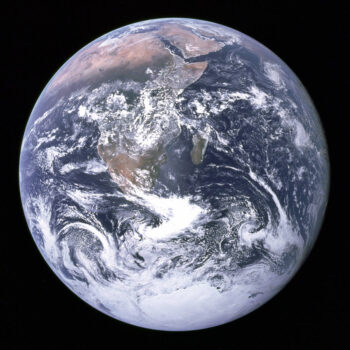
December 7th marks the 50-year anniversary of the famous “Blue Marble” photograph. This beautiful photo depicts Earth as seen by the Apollo 17 crew as they were on route to the moon. It has become one of the most reproduced images in history and is called the “Blue Marble” because the earth resembles crystal-like balls that are used in children’s games. This photo emphasized the need to take care of our planet and its environment.
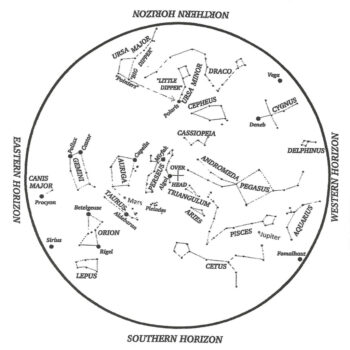
Hold star map above your head and align with compass points.
DECEMBER’S SKY
8: Full Moon
8: Mars at Opposition
13-14: Geminid Meteor Shower Peak
21: December Solstice
21-22: Ursid Meteor Shower Peak
23: New Moon
OBSERVATIONS
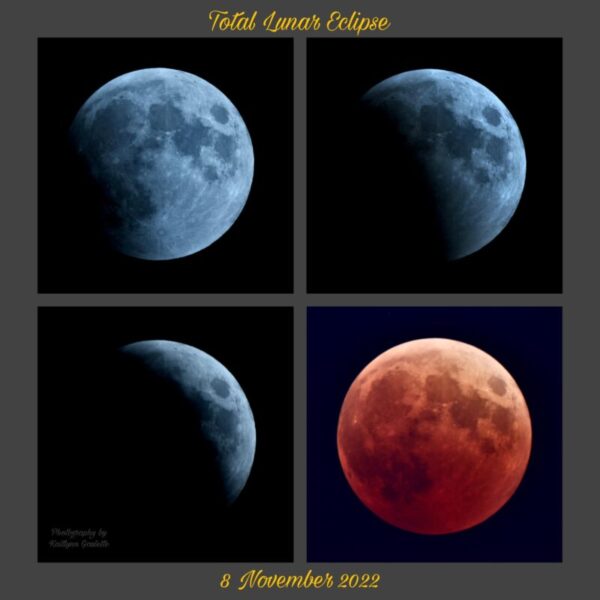
On the morning of November 8th, I woke up a few hours before the sun rose to prepare for a rare total lunar eclipse. I packed my Canon DSLR camera and 8-inch Newtonian telescope and traveled to a location with a low eastern horizon. I was joined by friends, family, and members of my high school Space and Astronomy Club.
The air was very crisp, and the skies were clear while we awaited totality. We were treated to the winter stars shining overhead and I gave a tour of the sky, reviewing the Winter Hexagon with club members as they discussed predictions of what the eclipse would look like. As totality arrived, the moon became completely engulfed in the earth’s shadow and displayed an orange-red color. Everyone was amazed at how dim the moon had become and took turns viewing it through Springfield STARS Club President, Richard Sanderson’s Dobsonian telescope.
Due to my location, this eclipse was very interesting. The sun rose as totality was still occurring, which caused the moon to become dimmer as the sky was getting brighter. Eventually, the moon faded from view and became invisible to the unaided eye. I hope you all got a chance to observe this rare event because the next total lunar eclipse won’t occur until the year 2025!
My recent observations have continued to include Jupiter and its Galilean moons. I’m working on a project that requires me to make observations of these distant satellites and time occultations of Io, Europa, and Ganymede. This project has taught me much about Jupiter and its moons, and how they interact. I will be continuing these observations for a few more months and look forward to the results.
OBJECT OF THE MONTH
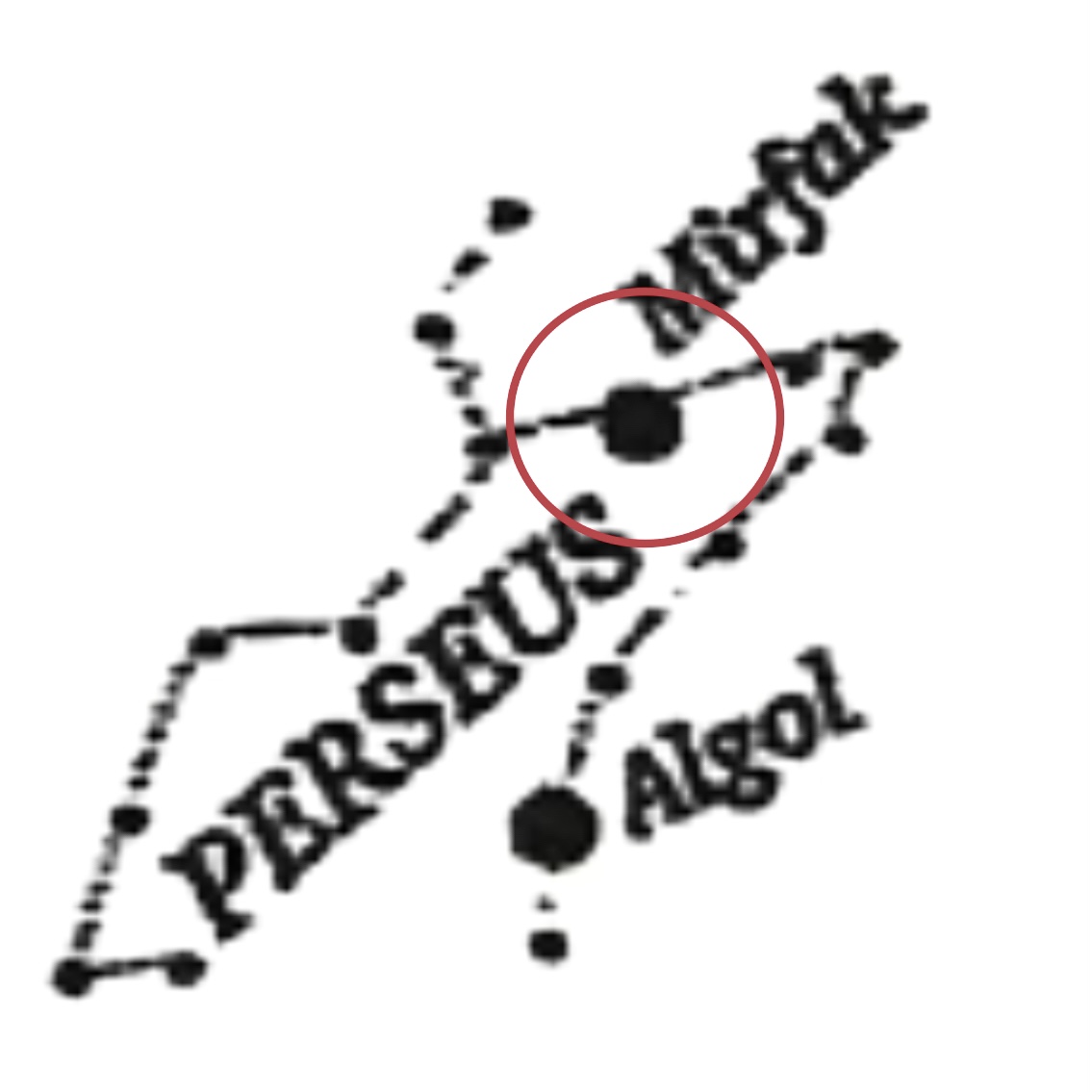
The featured object for the month of December is Melotte 20, a star group in the constellation Perseus. This object is also known as the Alpha Persei Group and is estimated to be over 33 light-years across. It’s comprised of about 100 stars at a distance of roughly 600 light-years. Astronomers debate whether this star group is a true galactic cluster because its stars are so dispersed, even though they have the same directional motion in space and were born from the same gas cloud. Whether it’s a cluster or not, it remains a spectacular object to observe with a pair of binoculars or a telescope at low power.
Melotte 20 can be found surrounding the bright star Mirfak in Perseus. Mirfak shines at about 1.8 magnitude and is the brightest of the Alpha Persei Group. This cluster is very bright and is visible with the unaided eye under dark skies. Use the star map below to help you find it.
The purpose of the Starry Scoop is to communicate current astronomy and space events. If you want to share your observations or get digital copies of the Starry Scoop, contact starryscoop@gmail.com. Clear skies!

Related Posts