
The Starry Scoop: July 2023
Read your monthly astronomy news with “The Starry Scoop” by Kaitlynn Goulette! Follow them on Facebook to have their updates placed directly on your feed!
Editor: Kaitlynn Goulette
July 2023, Edition 40
WHAT’S UP
This month, the Summer Triangle asterism can be found overhead dominating the eastern sky. It’s comprised of the stars Deneb, Vega, and Altair, each the brightest in their respective constellations. Stretching through this region is the edge-on view of the Milky Way, where countless deep sky objects can be found. One of my favorite targets in this region is Brocchi’s Cluster, more commonly known as the “Coathanger.” With a pair of binoculars, it can be found one-third of the way from Altair to Vega.
After sunset, Venus and Mars can be found in the western sky. On July 1st, they pass within 3.3 degrees of each other and as the month continues, Venus fades into the dusk. Later in the night, Saturn rises a little before midnight, but by month’s end, it appears around 9:30. On July 7th, the moon passes by the ringed planet at a distance of about three degrees. Jupiter rises in the east about two and a half hours after Saturn.
The Delta Aquarid meteor shower runs annually from July 12th to August 23rd and peaks this month on the night of the 29th into the following morning. Producing about 20 meteors per hour, this shower is the product of Earth traveling through the debris field left from Comets Marsden and Kracht. The nearly full moon blocks the fainter shooting stars, but the brighter ones are still visible. For best viewing, find yourself in a dark location after midnight.
On the 3rd, we are treated to a supermoon. This occurs when a full moon is at its closest approach to earth in its orbit. Over the next few months, we are treated to four supermoons in a row. When observed, a slight change in brightness and size can be noticed. A supermoon appears to be 7% larger than an average moon with the brightness being 16% more.
JULY’S SKY
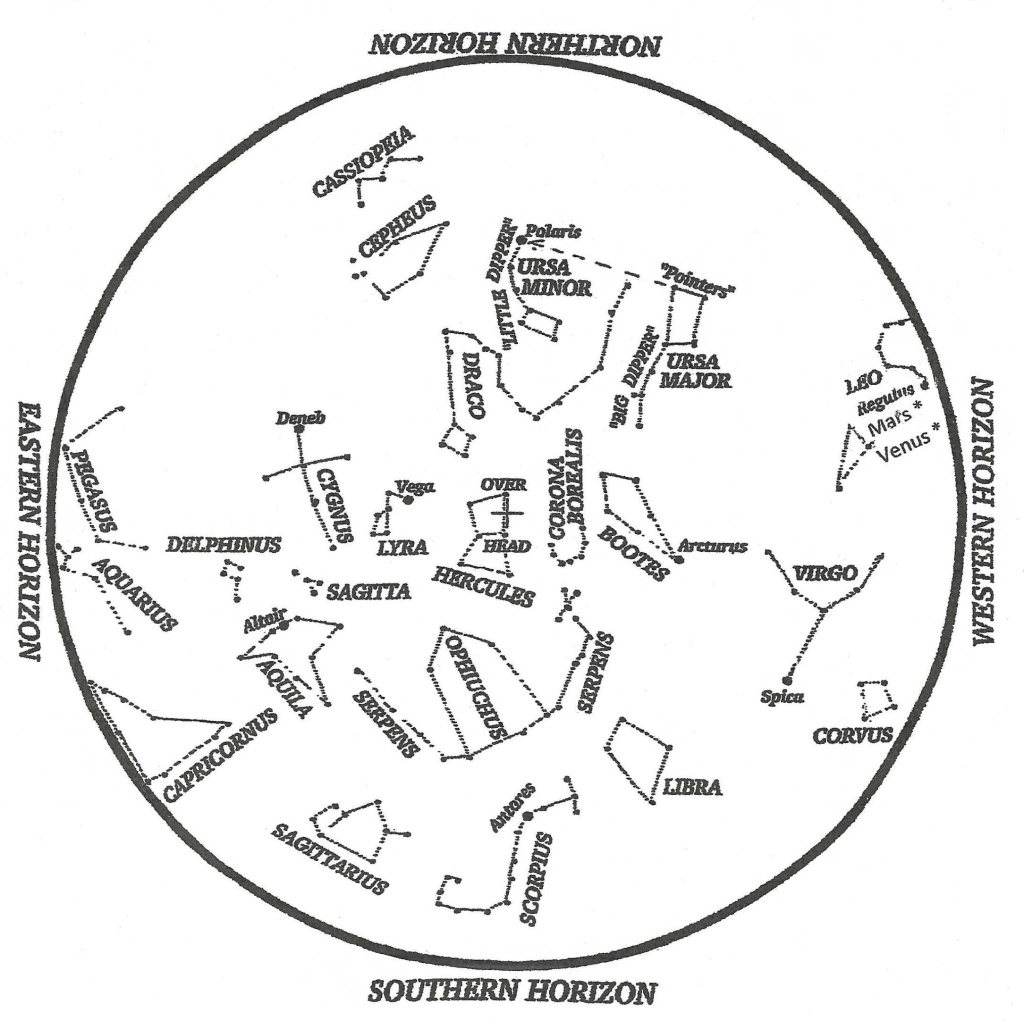
Hold star map above your head and align with compass points.
3: Full Moon, Supermoon
17: New Moon
29-30: Delta Aquarid Meteor Shower Peak
OBSERVATIONS
Recently, with the smoke-polluted skies and my busy schedule, I haven’t had many chances to stargaze. But on the evening of the summer solstice, June 21st, I was able to convince my father to drive me to the UMass Sunwheel to celebrate the start of summer with other astronomers.
The UMass Sunwheel in Amherst consists of a circle of large stones, which can be used as a calendar. On equinoxes and solstices, these stones mark where the sun rises and sets. Another great example of a solar calendar is Stonehenge, in England.
As attendees were arriving, Dr. Stephen Schneider provided a Coronado solar telescope to view the sun. Through the eyepiece we observed active regions on the surface and distinctive prominences along the sun’s limb. Afterwards, Dr. Schneider utilized hula hoops and Styrofoam balls to explain orbital mechanics and basic astronomy to the public.
Professor Judith Young began the Sunwheel project 23 years ago. Her goal was to bring awareness and appreciation of astronomy to UMass students, the public, and children. I’ve been attending Sunwheel events for about eight years and I have enjoyed the presentation during each visit. The next Sunwheel event takes place on March 20th for the Vernal Equinox. I hope to see you there!
OBJECT OF THE MONTH
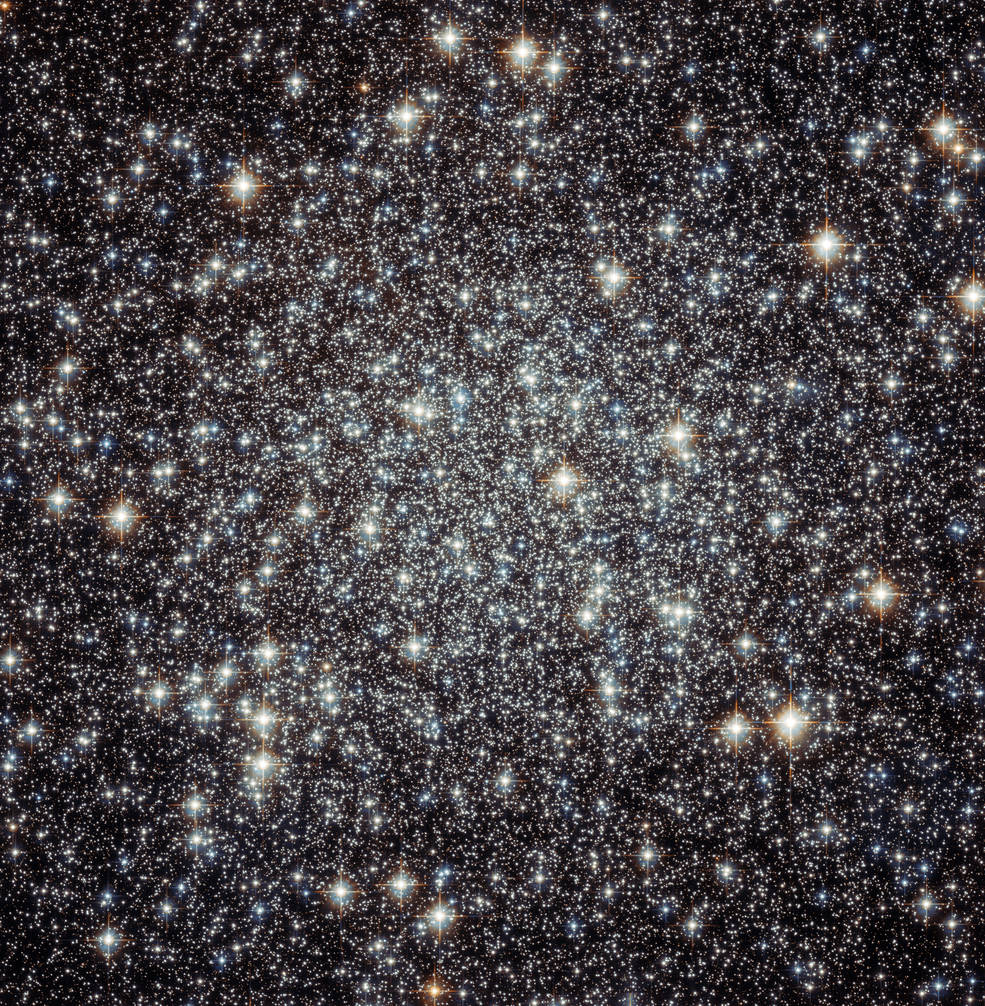
The highlighted object for June is Messier 22 (M22), located in Sagittarius. This globular cluster is one of the brightest in the sky and was discovered in 1665. It contains roughly 500,000 stars and lies about 10,600 light-years away. M22 contains a few additional attributes, including two stellar-massive black holes and a planetary nebula.
On an ideal night, M22 can be seen with the unaided eye and with a backyard telescope, hundreds of stars will be revealed. Find this object about 2.5 degrees northeast of the top star in the Teapot asterism.
The purpose of the Starry Scoop is to communicate current astronomy and space events. If you want to share your observations or get digital copies of the Starry Scoop, contact starryscoop@gmail.com. The Starry Scoop is now on Facebook. Clear skies!
Image: UMass Sunwheel, photo by Kaitlynn Goulette

Related Posts