The Starry Scoop: October 2023
Read your monthly astronomy news with “The Starry Scoop” by Kaitlynn Goulette! Follow them on Facebook to have their updates placed directly on your feed!
Editor: Kaitlynn Goulette
October 2023, Edition 43
WHAT’S UP
This month we are treated to a cosmic delight. An annular solar eclipse occurs on October 14th, which happens when the moon is positioned too far out in its orbit and does not cover the entire disk of the sun. The eclipse path travels across the southwestern United States and New England residents will see a partial eclipse. Make sure to use proper equipment and safe solar filters when viewing this special event. Eclipse glasses will be sold at the Springfield MA Museum Store.
October evenings welcome autumn constellations as they prepare to dominate the southern sky. Pegasus the flying horse is easily recognizable, especially the asterism known as the Great Square of Pegasus. Still high overhead is the Summer Triangle. It’s comprised of the 1st magnitude stars Deneb, Altair, and Vega, and features an edge-on view of the Milky Way, which passes directly through it.
Jupiter and Saturn are once again visible in our evening sky. They appear as the brightest star-like objects to the unaided eye and are breathtaking worlds when viewed through a telescope. Venus dominates our morning sky and is joined by the moon on the 10th. Much like the moon, Venus goes through phases that can be easily observed with a backyard telescope.
This month brings us the peaks of two meteor showers. The Draconids runs annually from October 6th to the 10th and peaks on the evening of the 8th into the following morning. This shower is unusual as it’s best viewed in the early evening hours. Later in the month, the Orionid meteor shower peaks on the 20th and 21st. This annual shower runs from October 2nd to November 7th and is produced by particles left behind by the famed Comet Halley. For best viewing, find yourself in a dark place after midnight.
One year ago on October 3rd, the James Webb Space Telescope released its first image of an exoplanet. The image was captured using four different light filters and marked the first time NASA had ever taken a direct image of a planet that lies outside of our solar system. This gas-giant planet has no solid surface and is about 6-12 times the mass of Jupiter. The image marked the starting point of in-depth study of remote worlds.
OCTOBER’S SKY
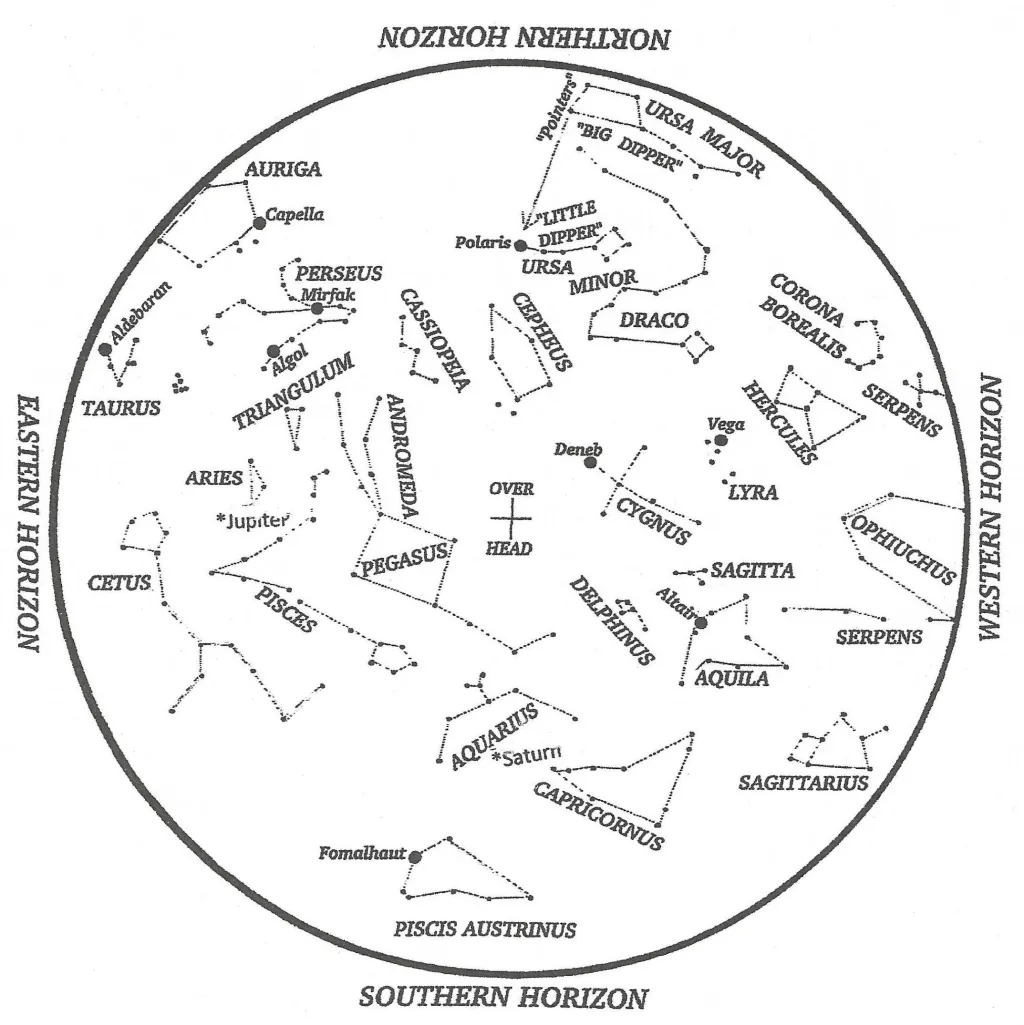
Hold star map above your head and align with compass points.
8-9: Draconid Meteor Shower Peak
14: New Moon
14: Annular Solar Eclipse
20-21: Orionid Meteor Shower Peak
30: Venus at Greatest Western Elongation
28: Full Moon
28: Partial Lunar Eclipse
OBSERVATIONS
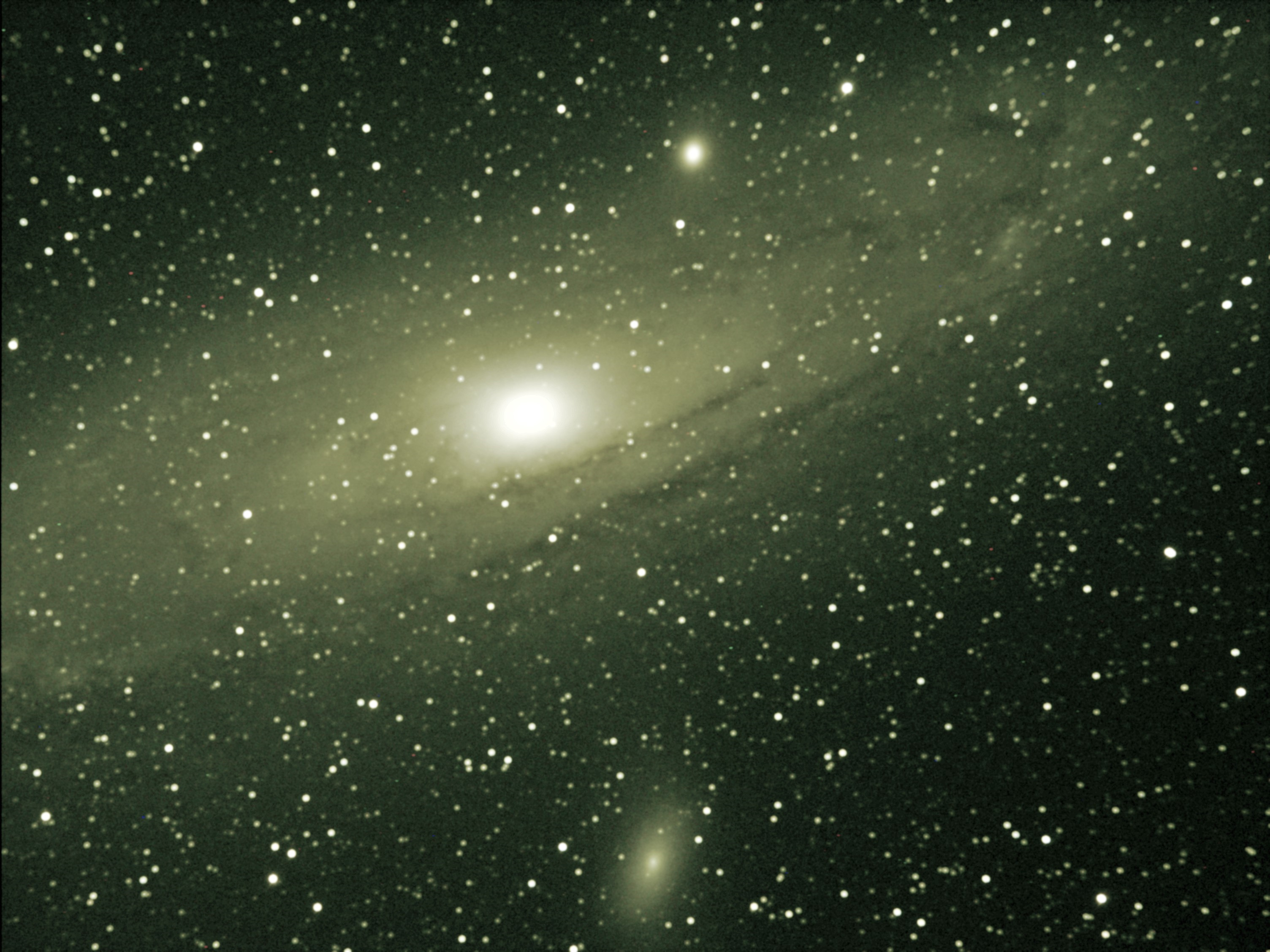
Putting Arunah Hill’s new observatory to work, my good friend Ed Faits, past president of the Arunah Hill Natural Science Center and the Springfield STARS Club, has been taking advantage of every clear night he can.
Ed has been focusing on astrophotography. Over the past few weeks, he’s been learning how to capture deep sky objects using his ZWO 533 camera. He utilizes Arunah Hill’s new Paramount MX Mount and his own Celestron Rasa 8-inch telescope. His targets include much of the Messier catalog and other celestial treasures.
Ed’s interest in astrophotography began when he built his first telescope with his father in 1966. Later, he bought a book by Hans Vehrenberg titled “Atlas of Deep-Sky Splendors.” This volume highlights images that the author had taken of over 400 deep-sky objects using the technology of the 1950s and 60s. Having access to 21st century equipment at Arunah Hill’s new observatory, Ed has recently decided to learn the inner workings of astrophotography and has set a goal of capturing every object in the book. He wants each image to be as good as or better than Vehrenberg’s.
Astrophotography seems to be taking over the astronomy world. Compared to visual observations, photography captures much more detail and is the natural progression for many amateur astronomers. In the future, I hope to join the bandwagon of astrophotography as well.
OBJECT OF THE MONTH
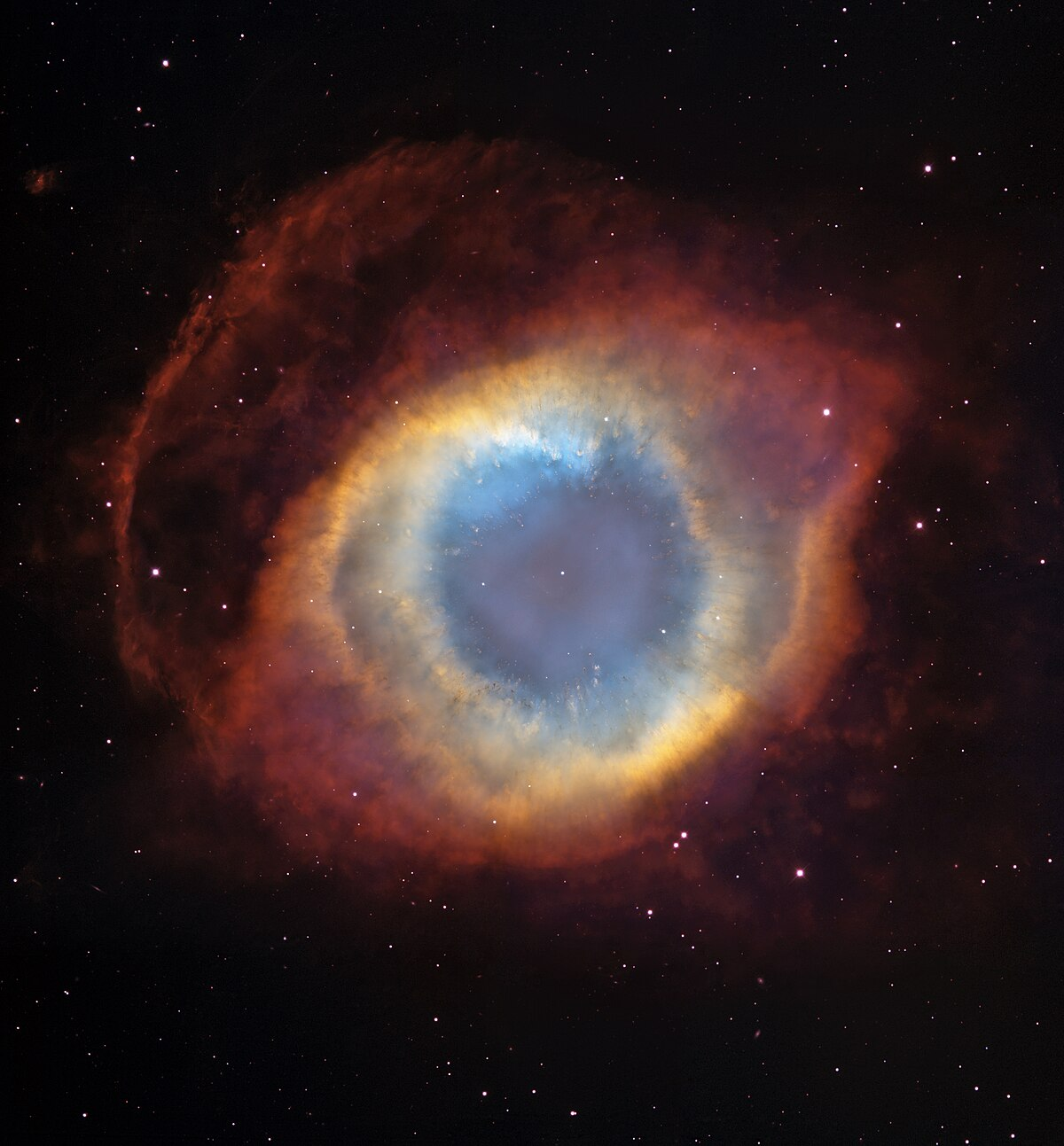
The featured object this month is the Helix Nebula, designated NGC 7293. This object is a planetary nebula and was formed by a dying star that ejected its outer layers of gas. At a distance of about 650 light-years, it’s one of the closest bright planetary nebulae to Earth. It spans roughly 2.5 light-years and is estimated to have an age of about 10,600 years.
Shining at 7.6 magnitude, this planetary nebula can be spotted with a pair of binoculars or a backyard telescope. Find it in the constellation Aquarius, about 12 degrees northwest of the bright star Fomalhaut.
The purpose of the Starry Scoop is to communicate current astronomy and space events. If you want to share your observations or get digital copies of the Starry Scoop, contact starryscoop@gmail.com. The Starry Scoop is now on Facebook. Clear skies!
Featured Image: Andromeda Galaxy by Ed Faits

Related Posts