
The Starry Scoop: September 2023
Read your monthly astronomy news with “The Starry Scoop” by Kaitlynn Goulette! Follow them on Facebook to have their updates placed directly on your feed!
Editor: Kaitlynn Goulette
September 2023, Edition 42
WHAT’S UP
The summer constellations, including the Sagittarius region, are beginning to drift to the west, taking the heart of our Milky Way with them, but remain visible for the entire month. This region of the sky is rich in deep sky objects and celestial treasures that are easily observable with binoculars and a backyard telescope.
This month, Saturn is visible in the southeast sky following sunset and moves higher along the ecliptic as the night continues. Saturn and its rings have been stunning telescopic targets, especially during its recent opposition. On September 26th, the waxing gibbous moon visits the ringed planet. Found roughly 10 degrees west of Saturn is the dim smile-shaped star pattern of Capricornus, which is a challenging constellation to find with the unaided eye. Later in the evening, Jupiter can be seen above the horizon at about 9pm and is a wonderful morning target. Due to its fast rotational period, new features are visible on its surface throughout the entire night.
Earning its name as our “Morning Star,” Venus is visible for a few hours before the sun rises. This world goes through phases much like the moon, as it’s an inferior planet. Mercury also appears in the morning sky and reaches greatest western elongation on the 22nd.
The September Equinox occurs on the 23rd of this month and marks the first day of fall for those of us living in the Northern Hemisphere. On this day, the sun is positioned almost directly above the equator and day and night hours are nearly equal throughout the world. The days will begin to get shorter and shorter, which is great news for astronomers as there’s more time under the night sky.
Twenty years ago on September 21st, the Galileo spacecraft ended its 14-year mission by plummeting into Jupiter. Over the course of its mission, Galileo orbited Jupiter 34 times, collecting data on both the planet and its moons. The spacecraft discovered evidence of a vast ocean beneath Europa’s icy crust and also carried a probe that was deployed into Jupiter’s atmosphere.
SEPTEMBER’S SKY
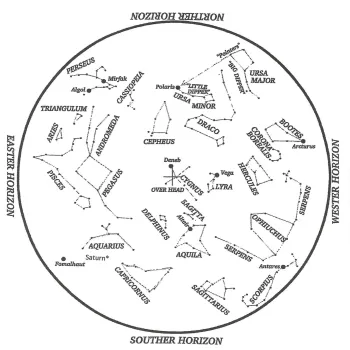
Hold star map above your head and align with compass points.
15: New Moon
19: Neptune at Opposition
22: Mercury at Greatest Western Elongation
23: September Equinox
29: Full Moon, Supermoon
OBSERVATIONS
Recently, I had the opportunity to stargaze under the dark skies of the Stellafane astronomy convention in Springfield, Vermont. I participated in my 5th Binocular Observing Olympics (BOO), which included a list of objects compiled by astronomer Phil Harrington. I completed this challenge alongside my sister, father, and Jenny Powers, director of the Springfield Science Museum. This was Jenny’s first Stellafane and her first time participating in the Binocular Observing Olympics.
I used my 7×35 binoculars for much of the challenge, but also utilized my tripod-mounted 15×75 binoculars to verify some of the fainter objects.
Once again, the binocular observing program was nothing short of a masterpiece. This year, it included not only challenging targets, but also popular deep sky objects and fun asterisms. My favorite objects were Davis’s Dinosaur in Hercules and the Polaris Engagement Ring in Ursa Minor, both unique asterisms. Some of the more challenging objects included NGC 6572 and NGC 188. We also spent a lot of time trying to discern NGC 604, a nebula and star-forming region, but were unsuccessful. This object was situated within galaxy M33, another target in the program. I’ll be sure to revisit this object next time I find myself under clear skies.
OBJECT OF THE MONTH
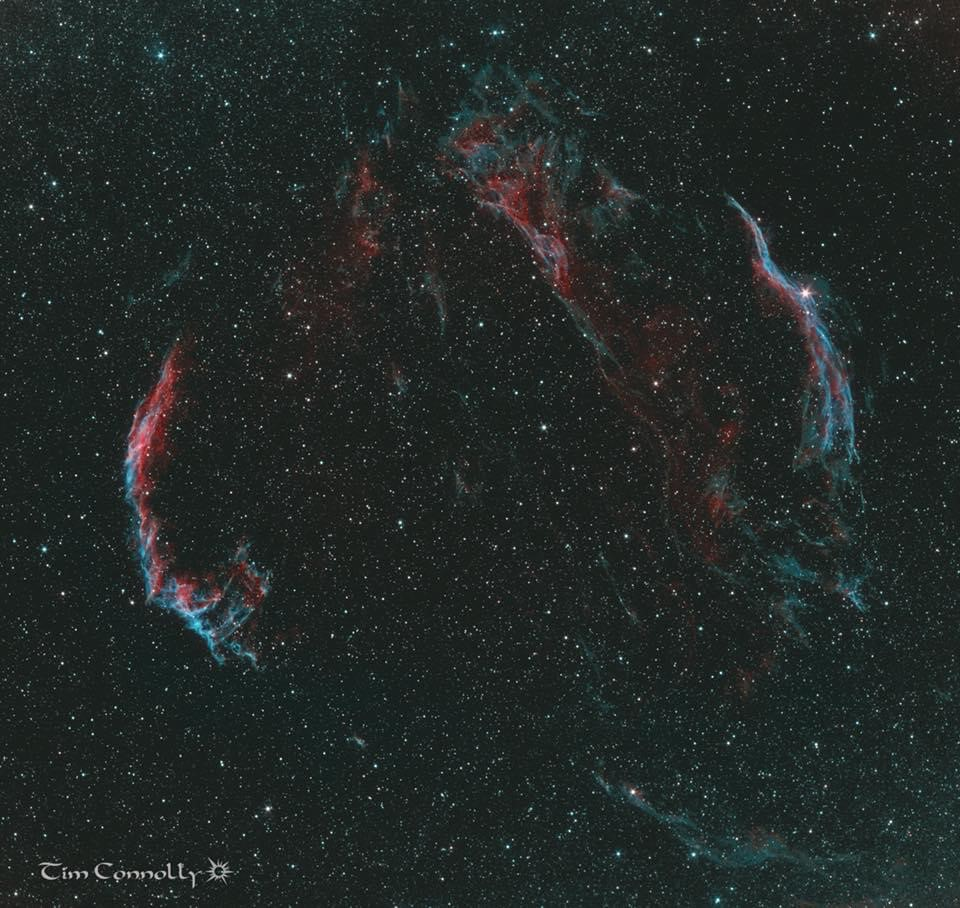
The featured object for the month of September is the Veil Nebula. This supernova remnant is the remains of an exploded star that was 20 times more massive than our sun. In the sky, it appears roughly six times larger than the full moon. The two brightest portions of the Veil Nebula are the Eastern Veil and Western Veil as we’re viewing them edge-on. Other sections of the Veil Nebula include Pickering’s Triangle and the “Funnel.”
Find the Veil Nebula in Cygnus, about four degrees southeast of Epsilon Cygni. This object is best viewed with a telescope, especially with an OIII filter, which significantly helps resolve its detail.
The purpose of the Starry Scoop is to communicate current astronomy and space events. If you want to share your observations or get digital copies of the Starry Scoop, contact starryscoop@gmail.com. The Starry Scoop is now on Facebook. Clear skies!
Featured Image: Stellafane – Breezy Hill

Related Posts