
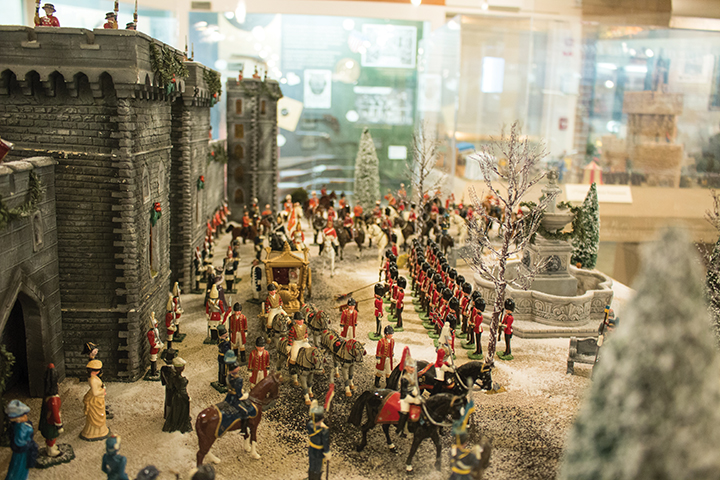
Formed in the 1970s, the Connecticut Valley Miniature Figure Collectors Club seeks to inspire interest in history through the collecting, painting, and display of miniature figures representing a wide array of subjects, time periods, and geographical areas. Scenes and figures can be collected depicting historic battles, coronations, and even royal weddings. Collectors meet and share displays at events and shows held across the country. As an example of the variety of figures available to today’s collector, featured in this exhibit are a 12th-Century Medieval Tournament and England’s Windsor Castle at Christmastime 1898.
Christmas at Windsor Castle 1898
Windsor Castle, located within the English County of Berkshire England was built in the 11th century and is the oldest and longest occupied castle in the world. It has been called home by British Royalty throughout its 1000-year history, and is still the weekend home most favored by the current Queen of England, Elizabeth II.
During the reign of Queen Victoria from 1837 – 1901, Windsor Castle saw new life as more diplomatic invitations were issued, and social events became more accessible for visitors with the advent of steamships and rail systems. Following the death of her husband Prince Albert in 1861, the Queen went into deep mourning and for many years was referred to as the Widow of Windsor, with the result being a decline of social events at the Castle. In her later years though, wishing to venture less and less from the boundaries of Windsor, the Queen once again partook of entertainments such as operas and plays, but mostly within the confines of the Castle. We would like to think that this scene, Christmas at Windsor Castle 1898, represents one of those holidays she most enjoyed as her reign was coming to a close.
12th Century Medieval Tournament
Popular in the Middle Ages and the Renaissance (the 12th -16th centuries), tournaments were competitions popular for their crowd-pleasing mock fights and equestrian showmanship. The most famous tournament fields were located in northeastern France. Taken from the French verb tornoier – to turn, the tournaments involved two opposing lines of knights who at the bugle sound or cry of a herald, “charged” each other, and with lances raised, sought to knock the opposing team off their horses. If you were fortunate to remain on your horse after charging the line, you would “turn” quickly and head back to single out knights to attack. Squires would remain at the edge of the fields, positioned in front of stands of spectators, and could offer their masters replacement lances. The men battled until they were either completely exhausted or until darkness fell on the field. The event didn’t end here though, as lavish banquets and the awarding of prizes continued well into the evening. It surely must have been a spectacle, and not one limited just to the locals. The greatest tournaments attracted knights from all over, including Germany, Iberia, Occitania, England and Scotland.