

Previously, we looked at the origins of star names. Many of them are from Arabic names for the Greek figures or from original Arab star patterns.
As for the constellations, although we think of them as Greek and use Greek names for them, the focus on certain groups of stars and their positions originated long before the Greeks. Most constellations were inherited from the Sumerians and the Babylonian empires of the Middle-East. The Greeks re-purposed these star-patterns to fit their own legends and myths. Of the 48 constellations listed by the Greek Ptolemy, only a handful are original Greek creations.
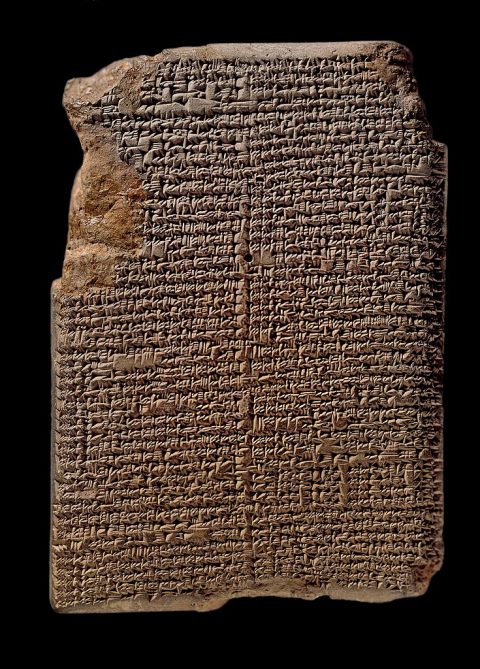
Although Babylon was ruled by various empires over its existence, the people kept a consistent set of deities and views of the heavens. They preserved the Sumerian language and cuneiform writing long after Sumerian had ceased to be a living language. The title of the great Babylonian astronomical work, MUL.APIN, is Sumerian. Through this preservation we can trace constellation history back to the Sumerians in some instances. We will look at some examples from the set of zodiac constellations.
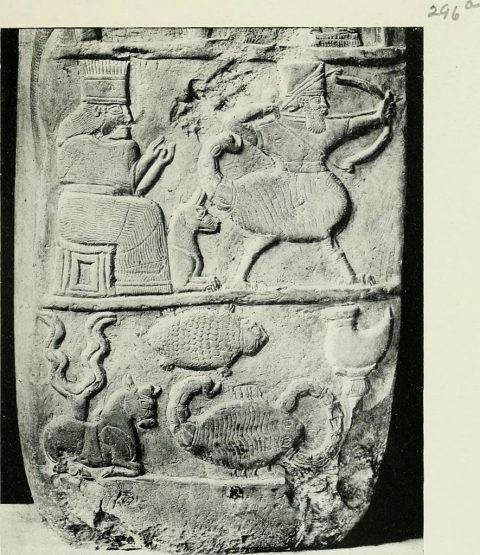
Bulls, lions, and to a lesser degree, scorpions are prevalent in Sumerian pictographs from about 3200 BCE that survive to this day. These animals are also depicted as constellations in the sky in this artwork. At that time, the constellations Taurus, Leo, and Scorpius rose just before dawn – a heliacal rising – at the spring equinox, summer solstice, and fall equinox, respectively. The winter solstice was marked by the constellation we know as Aquarius the water-pourer, which was known at that time as the god of earth and life Enki, who lived in the waters of the southern sky. These events helped the Sumerians to mark important times in the agricultural year and these representations remained in the zodiac for the rest of Mesopotamian history, although their interpretations shifted as new versions of the deities replaced the old.
The Sumerian god Enki was replaced by the Babylonian water-god Ea, and the icons associated with this god give us some other zodiac constellations. Ea’s sacred boat had a goat’s head carved on the bow. Later, this goat-boat morphed into another sea creature, a goat-fish, and became the constellation Capricornus to the right of Ea’s constellation Aquarius. Fish were sacred to Ea, and it is possible, but not as clear, that the constellation to his left, Pisces, is derived from his mythology. Ea was often pictured flanked by twins holding gateposts and guarding the doors. They eventually became the constellation Gemini. This constellation is across the sky from Aquarius, perhaps because the door was across the celestial room.
We will finish this brief excursion with a look at Virgo and a couple of associations with her. Her bright star, Spica, represents a grain of wheat. The Sumerian name for this star is Ab.sin, which meant “furrow.” They envisioned the ecliptic in this area as a furrow, and the star was planted in this furrow. The area nearby this star where Virgo is today was the location of the Babylonian fertility goddess Ishtar, whose Sumerian name was Inanna. Today Virgo is associated with fertility, especially in the Roman version Ceres, goddess of agriculture, from whose name we get the word “cereal”.
The plow creating this furrow was represented by the stars we know as Triangulum, and the plowman may have been the nearby Aries, named as “the hired farm laborer” in the MUL.APIN. The Sumerians considered the plow, which is next to Taurus and the spring equinox at the time, to be the first constellation of the year. It is the first entry in the book and thus gives its name, MUL.APIN, to the entire book.
With these few examples we see that, by considering the Sumerian and Babylonian origins of constellations, the placement of these star-groups in the sky makes more sense than just considering them to be connect-the-dot features. The next time you get out to enjoy the stars in the night sky you can think of yourself as an archaeologist as well as an astronomer!
Kevin Kopchynski is the planetarium educator at the Springfield Science Museum. He can be reached at planetarium@springfieldmuseums.org.
Reading List
- John H. Rogers. Origins of the Ancient Constellations: I. The Mesopotamian Traditions. Journal of the British Astronomical Association 108, 1, 1998.
- Craig Crossen. The Very Ancient Origins of the Water Constellations. Sky and Telescope, March 2015, p.36.
- Craig Crossen. The Ancient Circle of Animals. Sky and Telescope, January 2018, p.66.
Main image: Ea shown with attendants dressed in fish skins. Osama Shukir Muhammed Amin FRCP(Glasg), Wikimedia Commons