
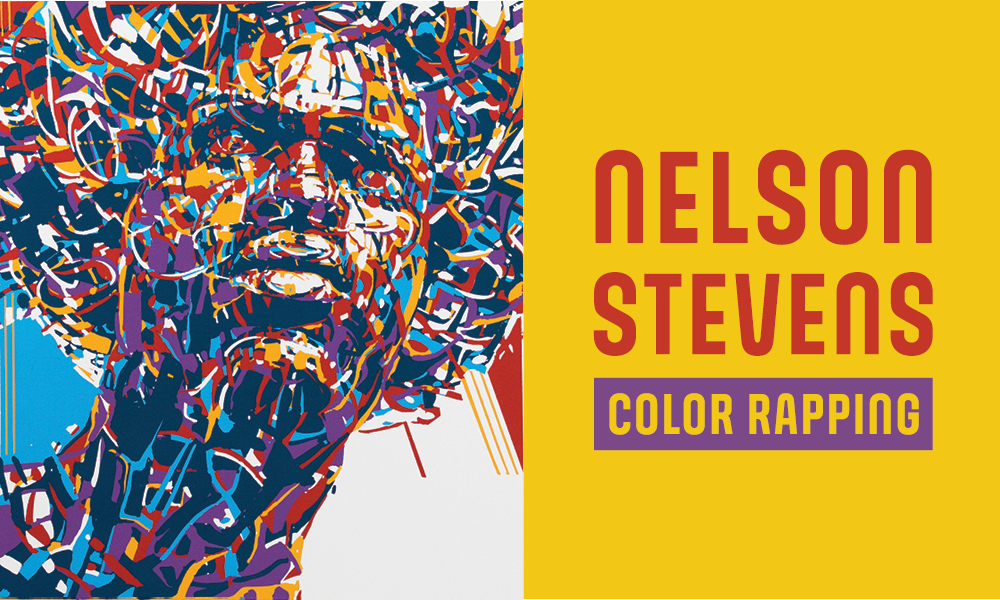
I create from the rhythmic color-rappin-life-style of Black folk. I believe that art can breathe life, and life is what we are about. −Nelson Stevens
The Springfield Museums is pleased to announce Nelson Stevens: Color Rapping opening to the public March 4, 2023, and on display through September 3, 2023, at the D’Amour Museum of Fine Arts. Organized by the University of Maryland Global Campus, this remarkable survey of the artist’s career pays tribute to the ingenuity, imagination, and indelible impact of Nelson Stevens, who worked at the intersection of art and activism. “I deal with the physiognomy of the soul of black folk,” said Stevens in an interview with the Guardian in 2019. “Our idea was to create the best art possible for our people.” This exhibit is not to be missed.
Nelson Stevens died in July 2022. The Springfield Museums staff had the great honor of spending time with him the previous summer, hearing directly from the vital artist his thoughts about art as a powerful means to make positive change. “When we started AfriCOBRA [African Commune of Bad Relevant Artists, started in 1968 in Chicago],” Nelson said, “we emphasized FREE. Af-FREE-Cobra.” Stevens spoke of his art as “anthems in praise of people.”
“We are saddened that Nelson cannot be with us to celebrate this incredible exhibit with his own words and in his own voice,” said Maggie North, Curator of Art for the Springfield Museums. “The exhibition pays tribute to his art, his spirit, and his impact.”
Artist, activist, and educator Nelson Stevens (American, 1938-2022) is renowned for creating powerful, rhythmic compositions that celebrate Black life and reveal his technical mastery of the figure. His works can be found in private collections and public museums, including the Art Institute of Chicago and Smithsonian National Museum of African American History and Culture.
This exhibition, spanning more than 50 years of the artist’s career, explores the political, cultural, and socioeconomic messages in Stevens’s art and style of painting. An early member of AfriCOBRA, and a professor at Northern Illinois University and the University of Massachusetts Amherst, Stevens spent decades alongside leading intellectuals of the Black Arts and Black Power movements. He was also deeply inspired by musicians such as John Coltrane and Archie Shepp whose rhythms and tempos influenced his bright, inventive painting style. Stevens’s experiences contributed to a legacy of vivid works that amplify African American culture and achievements.
From 1972 through 2003, Stevens taught in the W.E.B. Du Bois Department of Afro-American Studies at the University of Massachusetts Amherst and lived in Springfield for many of those years. In the early 1970s, he initiated a groundbreaking public art project that resulted in the creation of over 30 murals throughout the city. Like Stevens’s colorful paintings, the murals promoted Black empowerment and brought the pride and activism associated with the Black Arts Movement to western Massachusetts. The impact of the Black Arts Movement in smaller cities like Springfield has not been widely studied, although the movement, led by Stevens, had lasting effects.
Stevens said: “The objective of the program was to make the Black community an outdoor gallery so that each mural would be treated with the care of a stained-glass window.”
Kiara Hill, a professor of African American art history in the School of Art + Design at Portland State University, served as Curatorial and Interpretation Advisor for this important exhibition. She earned her B.A. at Sacramento State University, her M.A. at the University of Alabama, and recently completed her Ph.D. in Afro-American Studies at the University of Massachusetts. Her research interests include the Black Arts Movement of the 1960s and 1970s with an emphasis on Black women visual artists, Black Feminist Art, and Black Contemporary Art. Hill is also a curator of Black visual art and culture.
“Nelson Stevens was not only a prolific painter but a staunch community activist who, as an ‘image maker’ was committed to elevating the consciousness of Black folks right here in Springfield through the production of murals. For him, being an artist was so much more than aesthetics. It was about using one’s gift in service of a larger mission, which in this case was Black liberation,” says Hill. “Essentially, from his perspective, if your work was not in service of the people, what was the point? He unapologetically brought this same attitude to the classroom, which resulted in the production of over 30 murals. His influence on Springfield was and is still palpable, and my hope is that when people come to see the show, they leave with a more holistic understanding of who he was as an artist, activist, teacher, and humanitarian.”
Nelson Stevens: Color Rapping is organized by the University of Maryland Global Campus, where it was on view from September 25, 2022–January 8, 2023.
Exhibition supported in part by the National Endowment for the Arts, and the Springfield Cultural Council which is supported by the Mass Cultural Council, a state agency.

NEW ACQUISITION
Primal Force, 2019, signed serigraph by Nelson Stevens (American, 1938-2022). Museum purchase, 2022.D01.
Nelson Stevens (American, 1938-2022) describes his magnetic and brightly colored works as “anthems in praise of people.” Since the late 1960s, Nelson Stevens has created drawings, paintings, murals, and prints that are grounded in the Black experience. A participant in the Blacks Arts Movement and an early member of the Chicago-based art collective AfriCOBRA (African Commune of Bad Relevant Artists), Stevens created work intended to empower Black communities and promote Black liberation. From 1972 through 2003, Stevens worked as a professor in the Department of Afro-American Studies at University of Massachusetts Amherst, where he shared his philosophy with students. During the 1970s, Stevens brought AfriCOBRA’s “cool-ade colors” and aesthetic of empowerment Springfield when he collaborated with students and artists from the community to paint more than 30 murals throughout the city.
The serigraph Primal Force is evocative of motifs and imagery used in other works by Stevens, such as the print Uhuru at the Brooklyn Museum, which depicts the individual’s expression as serious yet hopeful. The creation of prints, which could be more easily disseminated and shared than unique paintings, has been important facet of Stevens’s work for decades, helping to make fine art accessible to more people. The acquisition of this Nelson Stevens serigraph is timely, as the work will be displayed in the upcoming exhibition Nelson Stevens: Color Rapping.