

Kick Up Your Curiosity—With Genealogy
“Don’t forget to kick up your curiosity and hit the road when you can. . . . We’d love to meet you and share our wonderful resources with you!”—Maggie Humberston, Curator of Library and Archives
Most years spring means family researchers dust off their notes and hit the road. Where to? For many it means back-tracking from south to north and west to east—at least if they’re coming to see us in the library at the Wood Museum of Springfield History. Western Massachusetts is the starting point for many families.
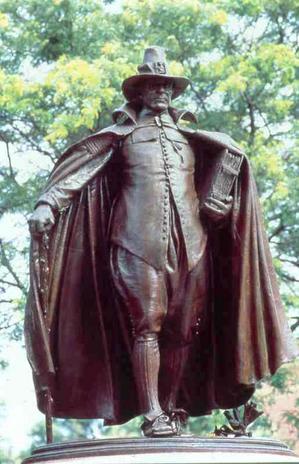
Chapins seem to be the most prolific family to come out of this area, based entirely and anecdotally on the number we see here every year! When yet another Chapin rolls in, we are not surprised that they are wide-eyed after enjoying a photo-op with Augustus St. Gaudens’s statue of the Puritan, which commemorates the first Chapin in America. Located in Merrick Park adjacent to the Springfield Museums campus, the Puritan keeps a stern eye on the goings on of the City of Springfield. I wonder if he records what he sees in the large volume he clasps under his left arm. He also graces the city’s municipal flag.
And he is a Chapin—the real deal! The wealthy nineteenth century railroad tycoon and industrialist Chester Chapin, Springfield born and bred, commissioned and posed for the statue to honor his several times great grandfather, Deacon Samuel Chapin (1598-1675), one of Springfield’s earliest and most prominent European settlers. The statue was dedicated at Stearns Square in 1887 and moved to its current site in 1899. Since no one knows where the Deacon is buried, this statue serves as a fitting tribute to a man whose descendants have flourished far and wide.
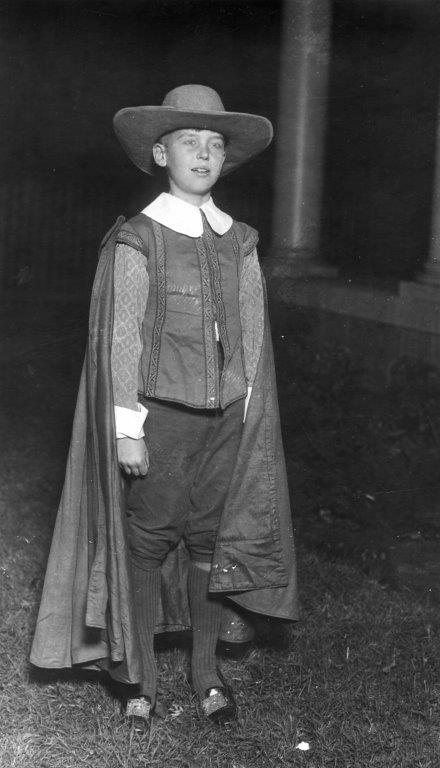
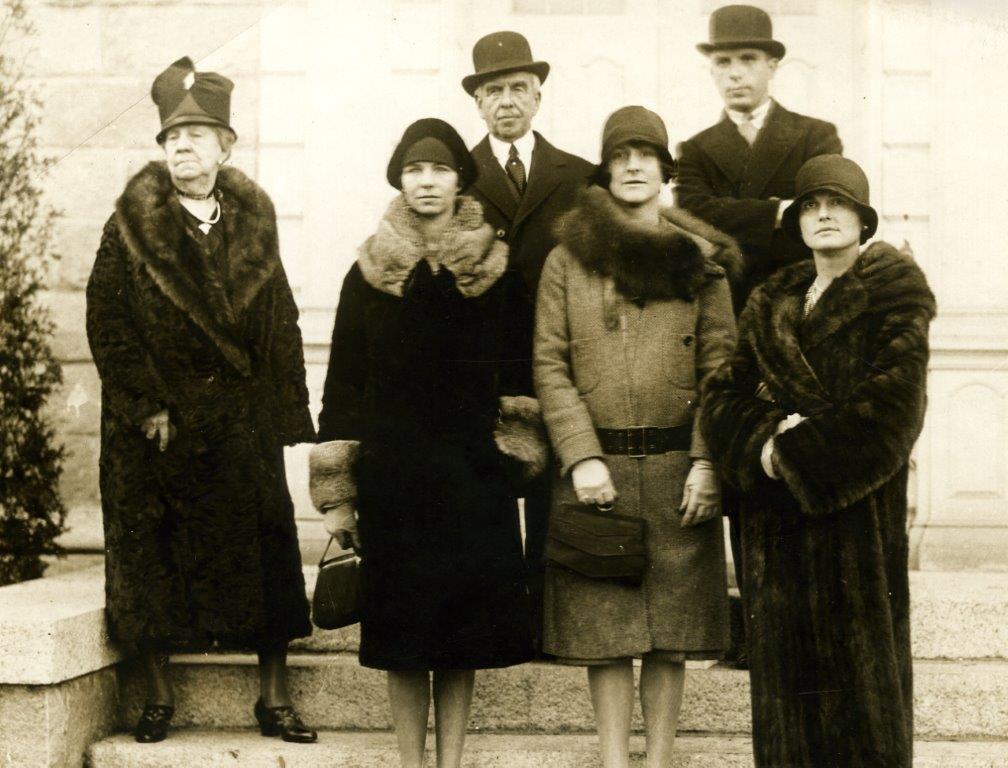
But William Pynchon is the founder of Springfield, even if he isn’t on our city’s flag! His descendants were in attendance in 1927 when the Connecticut Valley Historical Society opened up its museum and dedicated it to him. A young relative even appeared in a historical costume depicting his forebear. But they haven’t been seen much since. Pynchons are the rarest of the descendants of the early Springfield families to visit, or at least to make themselves known. In the many years I’ve been helping genealogists find their Western Massachusetts roots, only a time or two has a Pynchon descendant come calling.
William Pynchon (1590-1662) found his way from Roxbury to the community he named
Springfield in 1636 and he, with his son John, established a fur trading base here, which morphed from an outpost to a community fairly quickly. In essence, they got “a company town” going on the banks of the Connecticut River in the mid seventeenth century, and recruited farmers and artisans to live here. By loaning the capital these newcomers needed to get started, the Pynchons guaranteed that they would stay. A handful of other entrepreneurs soon joined them in forming towns along the river, and due to their economic power and influence these founding fathers were nicknamed “the River gods.” Sort of sounds like a nineteenth-century German opera! But William
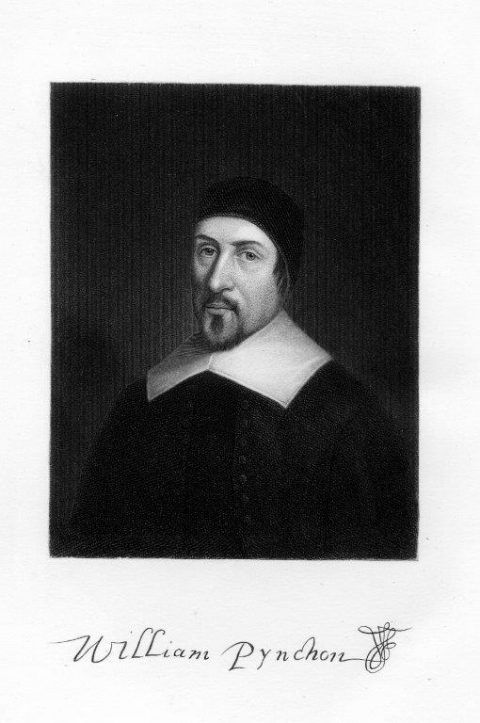
was more than a businessman and county magistrate. He also had an interest in things religious, which led him to challenge some of the established tenets of the Congregational ministry in New England. He wrote a rather inscrutable book, had it published in London in 1650, and shipped it over to Boston, where it met with strong censure and was declared “unsound and derogatory.” Indeed it was incendiary! It caused so much annoyance that the General Court ordered it to be burned by the town executioner on Boston Common. With his reputation in question, William soon saw the wisdom of returning to England, and he was accompanied by Springfield’s minister, the Rev. Moxon. John Pynchon, the heir to the Pynchon wealth in New England and later the West Indies, stayed on to oversee their assets in the New World and died here in 1702/03.
So, just a few weeks ago, we had a rare Pynchon descendant visit. Through our doors came an attorney from Northampton with his cousin from Florida. Both men had done a little research. They had read one of the newest biographies of William Pynchon written by Springfield’s native son David Powers, now a retired Congregational minister and scholar who lives on Cape Cod. His Damnable Heresy: William Pynchon, the Indians and the First Book Banned in Boston had piqued their interest. They had a specific request—to see if we had an original copy of William Pynchon’s book, which, as Power’s title implies, has the distinction of being the first book banned in Boston.
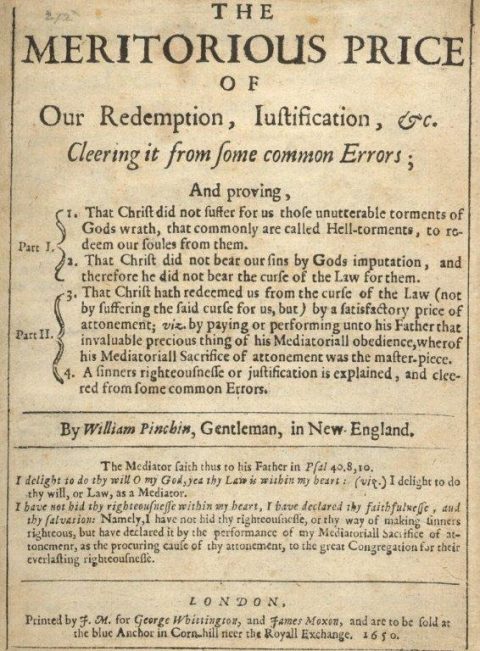
There are only a handful of copies of The Meritorious Price of Our Redemption still in existence today; estimates range between four and nine. We are the grateful owners of one, gifted over a hundred years ago by a Pynchon family member. The author is listed as “William Pinchin, Gentleman, in New England” and it’s interesting to note that one of the London publishers is a James Moxon. Could he be related to Springfield’s minister, the Rev. George Moxon? Since this is one of our most special archival treasures we were delighted to show it off to present-day Pynchons, and they were equally delighted to see it. With cell phones raised, photo taking ensued while stories unfolded of how a branch of Pynchons dispersed to the South, and settled in South Carolina, Georgia, and eventually in Florida. Turns out the Florida cousin has a son who’s a seminarian at Princeton, so with greater enthusiasm we retrieved our manuscript of John Pynchon’s sermon notes, taken in the meeting house overseen by the Rev. Moxon when John was a young teen. They are written in an eccentric shorthand, which David Powers turned his hand to deciphering a few years ago. The results appeared in another book
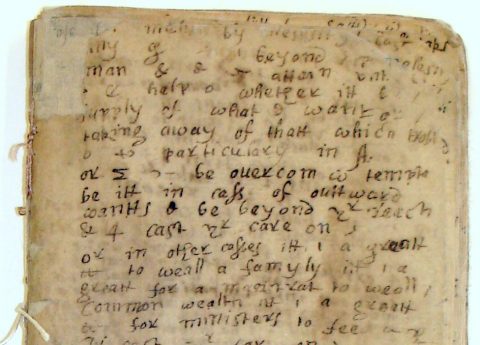
Good and Comfortable Words: the Sermon Notes of John Pynchon and the Frontier Preaching Ministry of George Moxon. My Florida Pynchon assured me sharing images of this text would make his son a hit in the dorm that evening. Again, fun for us to share.
Our Pynchon descendants knew William was not buried in Springfield but they wanted to have a sense of how the town might have been laid out long ago. They hoped to see where the grave stones ended up that were salvaged from the Old Burying Ground behind the First Church on Court Square. The stones had to be moved in the 1840s to make way for the railroad.
We have a map of old Springfield recreated in 1898 by Henry Burt, a local historian descended from one of the original founding families, which he painstakingly put together using the early land records of Springfield. He overlaid the locations of the house lots and
wood lots of the early families with the names of the downtown streets as they appeared in the late nineteenth century. These streets still exist today so it’s a straightforward process to get your bearings and find the location of the properties of those early European settlers. The map is invaluable for giving a sense of place, even though the space looks nothing like it did in the seventeenth century. Genealogists learn to develop great imaginations to go with their sleuthing skills!
The location of the reinforced structure where the Pynchons lived in the seventeenth century is on Fort Street. That space is occupied by The Fort restaurant, newly refurbished but a long-standing favorite for local fans of good food with a German twist. The restaurant gives pride of place to beautiful stained glass which celebrates Springfield history. Our visitors were unable to take advantage of its hospitality but hope to another time.
We hope they found their way to the Springfield Cemetery where there is a section by Pine Street devoted to the reinterred remains of those retrieved from the Old Burying Ground at Court Square. The removal of Pynchons was supervised by a descendant and a monument was erected to honor them, including Major John Pynchon, William’s son. However, most of the headstones of the early families that could be transported date from the eighteenth century forward.
While the Chapins and the Pynchons represent two prominent early European families of Springfield, many others came and contributed to the town’s development and success. Some stayed for generations while others passed through on their way to settle in other communities up the Valley.
If you’re curious about your Springfield family roots please come and visit. We are happy to share our research materials with you. One of our most unique resources is our four volume set of “Springfield Families” compiled by title lawyer Thomas Warren. He searched the old records, including wills and land deeds, and created multi-generation genealogies of Springfield families from settlement to 1850. It was a monumental task. We can thank the Mercy Warren Chapter of the DAR for typing and indexing it. We also have the vital records of Springfield, diligently compiled by Clifford Stott in a four volume, indexed set of births, marriages and deaths. Our manuscript collections include the vital records of seventeenth century Hampshire County (now present day Hampden and Hampshire Counties) personally kept by William and John Pynchon and the records of First Church from 1736. We also have other manuscript materials you can research by town or family. And we have many print genealogies and research notes gifted by genealogists who’ve benefited from using our collections.
While you can gather so much information online with databases like ancestry.com, GenealogyBank, and many others, it’s a special pleasure to walk the land and touch the original documents created by your forebears. If you’re lucky maybe some of their original homes are still standing, or objects they owned may exist in local museums or historical societies.
Right now is prep time, so stay on the couch and do all you can to find out what’s online. Get it organized, and contact family members to see what else you can learn, or verify. But don’t forget to kick up your curiosity and hit the road when you can. Load up your questions and come calling. Everywhere across this country are people who love their communities, know a lot about them, and would love to help you find out more about the folks and places you come from. And if you have roots in western Massachusetts, add us to the list—we’d love to meet you and share our wonderful resources with you!
Maggie Humberston is Curator of Library and Archives at the Wood Museum of Springfield History, one of the five Springfield Museums.

Related Posts